
TL;DR
Sports and fitness smartwatches combine activity tracking with smartwatch functions such as notifications, apps, payments, and music controls. Choose one by matching its GPS, heart-rate tools, battery, fit, and phone compatibility to the workouts you do; treat health and recovery readings as estimates that reveal trends, not diagnoses.
Your watch can draw a blue line across a running map, buzz when your pace slips, and still have enough battery to tell the time at dinner. Sports and fitness smartwatches bring workout tracking and everyday phone features together, but a crowded feature list does not tell you which watch will help with your actual routine.

Get sports gear delivered free with Prime
- Fast, free delivery on millions of items
- Prime Video, Amazon Music and more included
- Member-only deals all year
This guide explains what you get from GPS, heart-rate monitoring, sleep and recovery estimates, and training tools, along with the tradeoffs that can matter after the first week: battery, comfort, phone compatibility, subscriptions, and privacy. You’ll also get a practical way to compare watches without treating an estimated calorie count or nightly score as a precise measurement.
Whether you run before work, ride on weekends, swim laps, or simply want to move more, start with the activity you do most. A watch should make that activity easier to track and understand. It should not turn every morning into a test you can fail.
Pick built-in GPS if you want to record outdoor routes without carrying your phone; phone-assisted GPS can suit you if your phone is already along.
Use heart-rate and recovery readings to compare your own patterns over time, not as diagnoses or exact measurements.
For fast intervals where responsive heart-rate data matters, consider a chest strap alongside the watch.
Check comfort, battery use with GPS and music, water guidance, phone support, and subscription costs before buying.
If you are new to training, increase your workload gradually and seek qualified coaching when you need a plan.
What a sports smartwatch adds to your workouts and your day
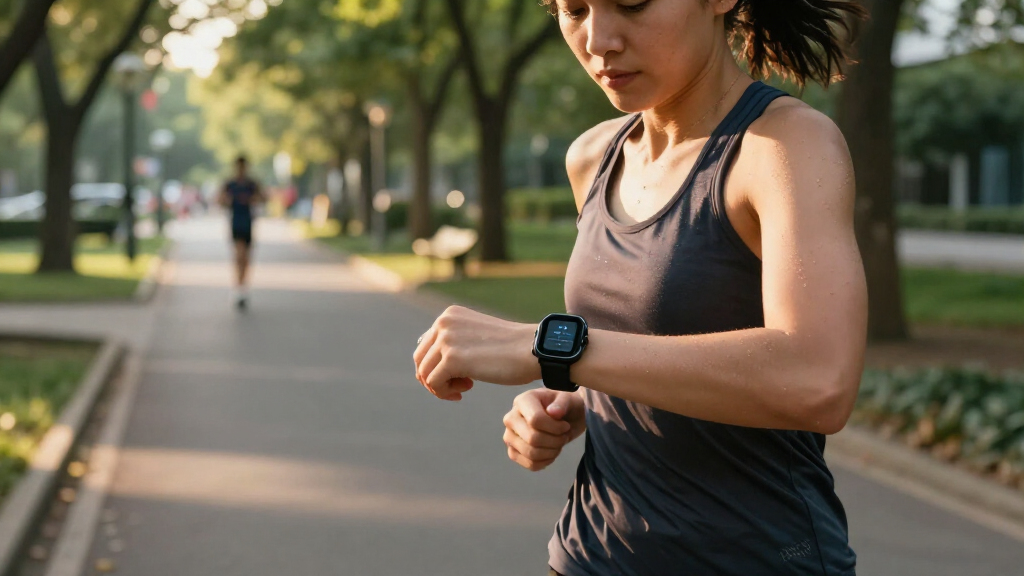
A sports and fitness smartwatch records activity and workouts while offering everyday features like notifications, apps, payments, and music controls. Most models track steps, workout duration, pace, distance, and estimated calories; some can record an outdoor route with built-in GPS. The practical difference shows up on an ordinary day: you can check a text at a trailhead, start a run from your wrist, and leave your phone in your pocket.
Compared with a basic fitness tracker, a sports smartwatch often offers more training tools and broader phone features. The category is broad: they range from everyday watches focused on health and convenience to rugged devices with outdoor navigation. That range matters. If you walk the dog and take a few spin classes, a heavy adventure watch may add bulk without adding much value.
Imagine you head out for a 30-minute jog after work. A watch might record the route, time, and estimated pace, then sync the workout to a phone app. Smartwatches combine activity tracking with smartwatch functions, but the exact mix depends on the model and phone. Check whether the features you care about, such as replying to messages or making payments, work with your device.
Before shopping, name the two or three things you want the watch to do. Maybe you want to log runs without your phone and receive calls at work. That short list gives you a better filter than a long product page.
Products Worth Considering

Garmin Index Sleep Monitor

Coleman Triton+ 2-Burner Propane Camping Stove with InstaStart

Solo Stove Bonfire 2.0 Smokeless Wood-Burning Fire Pit with Stand, 19.5-Inch, Silver
As an affiliate, we earn on qualifying purchases.
Choose GPS and workout tracking that match your usual route
Built-in GPS records outdoor distance and route without relying on your phone, while workout tracking organizes pace, time, and other exercise data. The signal can weaken near tall buildings, thick tree cover, and steep terrain, so a map is useful evidence of a route, not a perfect ruler. If you run the same neighborhood loop, consistent measurements may matter more than an impressive list of satellite options.
Some watches use a connected phone’s GPS instead, which can lower the watch’s price or conserve its battery. That works well when your phone comes along anyway. If you want to jog hands-free or hike without carrying it, built-in GPS is more convenient. Higher-end sport watches may add multiple satellite systems, maps, route guidance, or an altimeter; decide whether you’ll use those features before paying for them.
Try this comparison before buying:
| What you do | Feature to prioritize | Example tradeoff |
|---|---|---|
| Run around town | GPS and readable pace | Buildings may affect route accuracy |
| Hike unfamiliar trails | Navigation and battery | More rugged watches can feel large |
| Cycle outdoors | GPS, workout views, and platform support | Some data may be easier to review on a phone |
| Train indoors | Comfort and workout modes | Built-in GPS may matter less |
For example, a weekend hiker who follows marked trails may benefit more from route guidance and long battery life than a runner who mostly wants pace alerts. GPS is most useful when it solves a real problem in your routine.
Use heart-rate and recovery readings as clues, not verdicts
Wrist heart-rate monitoring estimates your pulse throughout the day and during exercise, while sleep and recovery features summarize patterns such as sleep duration and overnight heart rate. Heart-rate variability, often shortened to HRV, may appear in some models too. These measurements can help you notice changes over time, but they are estimates and do not diagnose a health condition.
A pattern is easier to interpret when you compare similar situations. Say your usual easy run feels comfortable and your watch shows a familiar heart-rate range. If the same pace feels unusually hard for several days, that combination may prompt you to rest, adjust the workout, or ask a coach for advice. A single low “readiness” score after a late night does not tell the whole story.
Wrist readings can be less reliable during intense intervals or movements that disrupt the sensor’s contact with your skin. If a precise, responsive heart-rate measurement matters for a session, a chest strap may be a better fit. Calorie estimates also remain approximate; don’t treat a watch’s number as an exact allowance for how much to eat.
Use wearable readings to spot patterns, then make decisions with your training context and how you feel. A consumer watch does not replace clinical equipment or professional medical advice.
For instance, an overnight score can give a cyclist something to compare across a busy workweek. It cannot tell them whether a persistent symptom is harmless. For concerning symptoms, speak with a medical professional rather than waiting for a watch to settle the question.
Pick training tools you’ll actually use between workouts
Training features help when they turn information into a useful next step. Depending on the watch, you may see pace or heart-rate zones, guided workouts, training-load estimates, recovery suggestions, or race goals. These tools can be helpful if you follow a plan and review the results; they can feel like noise if you only wanted to record a walk.
If you’re new to running, begin with a comfortable schedule and increase training gradually. A watch might prompt you to try intervals, but a beginner should build a steady base before chasing faster splits. A qualified coach can help you shape a plan around your experience, goals, and recovery. Stop if you feel pain or become unwell, and seek professional advice when needed.
Here’s a simple way to put a training watch to work:
- Choose one goal, such as running three times a week or riding a familiar route more comfortably.
- Record a normal week before changing your routine, so you have a personal baseline.
- Review a small set of metrics, like workout time and pace, instead of reacting to every score.
- Make one gradual adjustment, then see how your body responds over the next few sessions.
- Ask a coach or clinician for help when you need a training plan or health guidance beyond a watch’s capabilities.
For example, if your easy run starts feeling harder while your schedule has grown busier, the answer may be a rest day rather than another alert-driven workout. Useful guidance supports your judgment; it does not replace it.
Check battery, fit, and water guidance before you commit
Battery life depends on the model and the settings you use. GPS workouts, an always-on display, music playback, and frequent sensor readings can all shorten runtime. A basic fitness-focused watch may last several days, while a feature-rich model can need charging sooner when you use GPS often. Product estimates vary, so compare them against your expected use rather than assuming every advertised figure applies to your routine.
Comfort matters just as much. A rugged case can take rough outdoor use, yet feel heavy on a smaller wrist or awkward overnight. A snug band helps keep the sensor in contact with your skin; an overly tight one can irritate it. If you want sleep trends, you need a watch you can wear comfortably to bed, not just one that looks great on a display stand.
Water resistance is model-specific. Before you swim or shower, check the manufacturer’s rating and guidance; water resistance does not promise suitability for every depth or water sport. A pool swimmer should confirm the watch supports their intended use, while a runner who only gets caught in rain may have different needs.
Think through a real week: you wear the watch to the office, track three runs, listen to music on one, and sleep with it most nights. If you would have to charge it every evening, that routine may get old quickly. If charging is easy and you want a bright display, the tradeoff may feel fine. Comfort and battery habits are part of the feature set, because a watch you leave at home cannot track anything.
Match the watch to your phone, budget, and privacy needs
Phone compatibility and the surrounding app ecosystem shape what your watch can do after a workout. Some features may require a specific operating system, a connected phone, cellular service, or a paid subscription. Check whether calls, messages, payments, health syncing, and workout exports work with your phone before buying. Functions such as music playback or advanced coaching may also depend on particular services or plans.
A less expensive model can be a smart choice if you mainly want steps, basic workout logs, and notifications. More money may buy detailed maps, longer GPS runtime, rugged construction, or specialized training tools. Consider a cyclist who already reviews every ride in a familiar app: data export and compatibility may matter more than a flashy watch display. Check the current feature list, since subscription terms and included tools can change.
Privacy deserves a place on that list too. A watch may collect sensitive health and location data, so read what the app stores, shares, and retains. If route history or health details feel personal, review account settings and choose sharing options deliberately. Convenience does not require broadcasting every run.
Before you pay, make a short checklist: phone support, the specific features you’ll use, any ongoing subscription, and how the company handles your data. If a core feature depends on a plan, include that recurring cost in your comparison. The right purchase is the one whose ongoing costs and data practices still make sense after the excitement of unboxing wears off.
Frequently Asked Questions
What’s the difference between a fitness tracker and a sports smartwatch?
A fitness tracker usually focuses on activity and basic health measures. A sports smartwatch often adds more workout tools, GPS options, navigation, apps, and phone features such as notifications or payments. The exact difference varies by model, so compare features you’ll use.
Do I need built-in GPS?
Built-in GPS helps you record outdoor routes without carrying your phone. If you always bring your phone, a watch that uses the phone’s GPS may be enough. GPS accuracy can vary near tall buildings, dense trees, and steep terrain.
How accurate are smartwatch heart-rate and calorie readings?
Wrist heart-rate readings can help you follow broad patterns, but intense or irregular movement may affect them. Calorie counts are estimates, not exact measurements. If precise, responsive heart-rate data matters for intervals, consider a chest strap.
Can I swim or shower with a sports smartwatch?
Check the specific model’s water-resistance rating and manufacturer guidance first. A water-resistance claim does not mean the watch suits every depth or water sport. Confirm that it supports the activity you plan to do.
Do sports smartwatches need a subscription?
Core activity and workout tracking may be included, while some brands charge for advanced coaching, reports, or historical insights. Check the current feature list and ongoing costs before buying, because included tools can vary by model and plan.
Conclusion
Choose a watch around the workouts you already do and the information you’ll act on. Prioritize fit, battery, compatibility, and the tracking features that solve a real problem; treat estimated recovery, calories, and heart rate as helpful clues with limits.
Start with one goal, wear the watch for a few ordinary weeks, and let the trends inform your next step. The best data is the kind that gets you out the door, then fades into the background while you enjoy the road ahead.