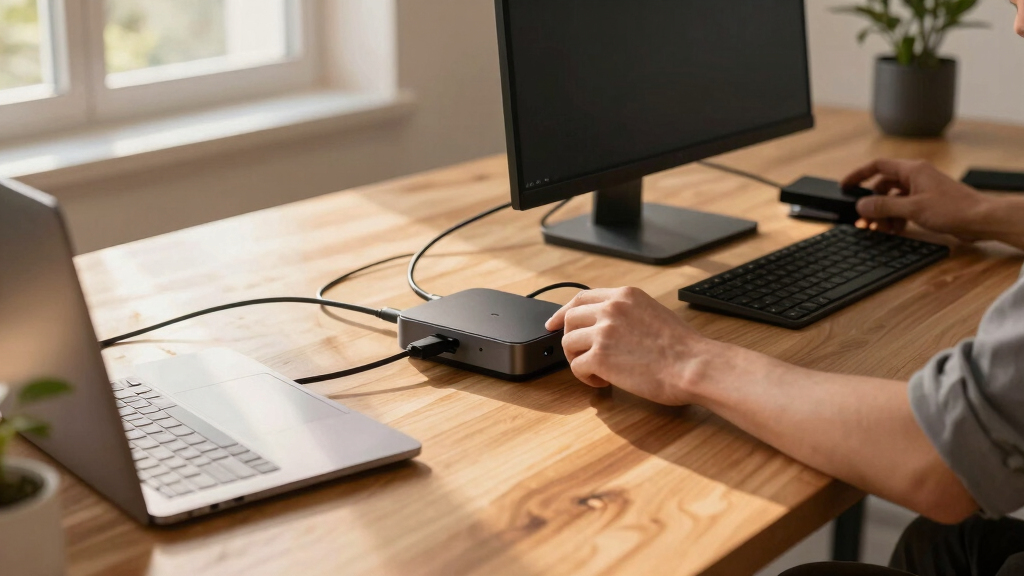

Finding the best docking station for a creator desk involves balancing multiple factors like display support, power delivery, and port variety. The Plugable Universal Docking Station stands out for its universal compatibility and reliable performance, making it a top overall choice. For those needing extensive monitor support, the TobenONE 20-in-1 Triple Monitor Docking Station offers unparalleled connectivity. Meanwhile, the Baseus Spacemate provides a compact yet feature-rich solution at a more accessible price point. Each option comes with tradeoffs—such as size, cost, or compatibility—so understanding your specific workflow is key. Continue reading for a detailed breakdown to help you choose the best docking station for your creator setup.
Key Takeaways
- Top picks balance display capabilities with power delivery to support demanding creator workflows.
- Compatibility varies significantly; some docks require drivers or are optimized for specific operating systems.
- Port variety and expandability often determine suitability for complex multi-monitor setups.
- Size and design matter—compact docks are convenient but may restrict port options or performance.
- Higher-priced options generally offer more robust build quality, higher wattage charging, and better future-proofing.
| Plugable Universal Laptop Docking Station with Dual HDMI, Gigabit Ethernet, and 6 USB Ports |  | Best Overall for Basic Dual Monitor Setup | HDMI Outputs: 2 | Max Resolution (Dual Display): 1920×1200 @60Hz | Ethernet Speed: Gigabit | VIEW LATEST PRICE | See Our Full Breakdown |
| Baseus Spacemate (Win) 11-in-1 Docking Station with Triple Display and 10Gbps USB Ports |  | Best Compact Multi-Display for Space-Conscious Creators | Total Ports: 11 | HDMI Ports: 2 | DisplayPort Connectors: 2 | VIEW LATEST PRICE | See Our Full Breakdown |
| Plugable 13-in-1 USB-C Triple Monitor Docking Station with 100W Charging |  | Best Versatility with Triple Display and Universal Compatibility | Hardware Interface: Thunderbolt 4 Compatible | Supported OS: Windows 10/11, macOS 11+, ChromeOS | Total Ports: 13 (3 HDMI, 4 USB-A, 2 USB-C) | VIEW LATEST PRICE | See Our Full Breakdown |
| TobenONE 20-in-1 Triple Monitor Docking Station for MacBook and Windows |  | Best High-End Triple Monitor Powerhouse | Display Ports: 3 HDMI + 2 DP | Resolution Support: Triple 4K@60Hz | Charging Ports: 2x 45W USB-C (100W total) | VIEW LATEST PRICE | See Our Full Breakdown |
| Anker Prime Docking Station (DL7400), 14-Port Triple Display with DisplayLink, 140W Max |  | Best High-Performance Multi-Display Hub | Ports: 3.5mm Audio, DisplayPort, Ethernet, HDMI x2, MicroSD, USB-C (10Gbps/5Gbps), USB-A | Wattage: 140W | Display Support: Triple 4K@60Hz or one 8K | VIEW LATEST PRICE | See Our Full Breakdown |
| TobenONE Dual Monitor Docking Station with 4K@60Hz, 100W Power Supply, and Gigabit Ethernet |  | Best Overall for Space-Saving Dual Monitor Setup | Display Support: 2x HDMI (4K@60Hz) | Power Supply: 100W PD 3.0 | USB Ports: 6 (USB-C + USB-A, up to 10Gbps) | VIEW LATEST PRICE | See Our Full Breakdown |
| Selore 16-in-1 USB-C Docking Station with Triple HDMI and 10Gbps Ports | 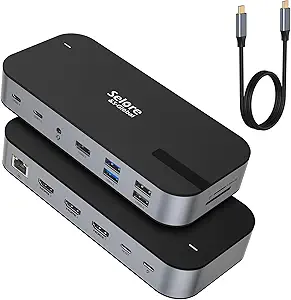 | Best for Multi-Monitor Professionals Needing Extensive Connectivity | HDMI Ports: 3x (4K@60Hz) | USB-C Ports: 2 | USB-A Ports: 3 (including 2x 3.1) | VIEW LATEST PRICE | See Our Full Breakdown |
| Anker 8-in-1 USB-C Docking Station with Dual HDMI and Ethernet |  | Best for Compact, Dual 4K Display Needs | HDMI Ports: 2 (4K@60Hz) | Ethernet: 1 Gbps | Power Delivery: 85W | VIEW LATEST PRICE | See Our Full Breakdown |
| TobenONE Triple Monitor Docking Station with 120W Power Adapter |  | Best for Heavy Multitasking with Triple/Quad 4K Support | Ports: 3x HDMI, 3x DP, 2x USB-C, 4x USB 3.2, SD/TF, Ethernet | Power Adapter: 120W (up to 100W laptop charging) | Display Support: Triple/Quad 4K@60Hz | VIEW LATEST PRICE | See Our Full Breakdown |
| Anker Prime Docking Station with 14 Ports, 160W Output, and Dual Display Support |  | Best for High-Powered, Versatile Connectivity | Ports: 14 including USB-C, HDMI, Ethernet | Max Output: 160W | Display Support: Dual 4K | VIEW LATEST PRICE | See Our Full Breakdown |
| WAVLINK DisplayLink Quad Monitor Docking Station with Thunderbolt 4/3 and USB-C |  | Best for High-Resolution Multitasking and Professional Creators | Interface: Thunderbolt 4/3, USB-C/A | Max Resolution: 5120x1440p60 (5K Ultrawide) or 4096x2160p60 (Cinema 4K) | Ports: 4 HDMI, 4 DisplayPort | VIEW LATEST PRICE | See Our Full Breakdown |
| Plugable Dual 1080p HDMI Docking Station for USB-C & USB 3.0 Laptops with 10 Ports |  | Best for Budget-Conscious Office Productivity with Multiple Displays | Hardware Interface: USB 3.1 Type A, USB 3.1 Type C | Compatible Devices: macOS 11+, Windows 10+, ChromeOS | Total Ports: 12 (including 2 HDMI) | VIEW LATEST PRICE | See Our Full Breakdown |
| Anker Nano 13-in-1 USB-C Laptop Docking Station with Detachable Hub |  | Best for Portable Power and Versatile Multi-Display Support | Ports: 2 HDMI, 1 DisplayPort, 3 USB-A, 5 USB-C | Display Support: Triple 4K via HDMI and DisplayPort | Power Delivery: 100W max PD, 140W input | VIEW LATEST PRICE | See Our Full Breakdown |
More Details on Our Top Picks
Plugable Universal Laptop Docking Station with Dual HDMI, Gigabit Ethernet, and 6 USB Ports
This dock stands out for its straightforward support of dual HDMI displays up to 1920×1200, making it a reliable choice for creators who need a simple, no-fuss setup. Compared with the Baseus Spacemate, it lacks support for triple displays or 4K resolution, but it offers a broader OS compatibility and a solid 2-year warranty. Its primary tradeoff is the absence of laptop charging and support for higher resolutions, which might limit its usefulness for power users or those working with high-res media. It’s ideal for creators prioritizing dual displays and broad device compatibility without the need for 4K or charging features.
Pros:- Supports dual monitors at 1920×1200 @60Hz for efficient multitasking
- Includes multiple connectivity options (HDMI, Ethernet, USB ports)
- Offers a 2-year warranty with lifetime support for peace of mind
Cons:- Requires manual driver installation for Mac, which can be inconvenient
- No support for 4K resolution or laptop charging limits its versatility
Best for: Creators who need dependable dual HDMI monitors and standard connectivity without high resolution or charging requirements
Not ideal for: Power users needing 4K or triple monitor setups, or those wanting to charge their laptops through the dock
- HDMI Outputs:2
- Max Resolution (Dual Display):1920×1200 @60Hz
- Ethernet Speed:Gigabit
- USB 3.0 Ports:2
- USB 2.0 Ports:4
- Compatibility:Windows 7-11, macOS 10.14+
Bottom line: This dock suits creators who need a reliable, budget-friendly dual display solution without high-res or charging capabilities.
Baseus Spacemate (Win) 11-in-1 Docking Station with Triple Display and 10Gbps USB Ports
This compact dock excels at supporting triple displays via HDMI and DisplayPort, making it ideal for creators who need expansive screen real estate without clutter. While it offers impressive 10Gbps data transfer and 100W power delivery—comparable to the TobenONE 20-in-1—it’s primarily optimized for Windows, with macOS users limited to single-display extension. Its small footprint and LED status display add convenience, but the lack of a included power adapter and limited audio options can be drawbacks for those needing all-in-one connectivity. This makes it a great fit for creators with space constraints who prioritize multiple high-res monitors and fast data transfer.
Pros:- Supports triple 4K@60Hz displays for expansive workflows
- Fast 10Gbps data transfer on USB 3.2 ports
- Compact upright design with intuitive LED status display
- Power delivery up to 100W for compatible laptops
Cons:- Requires a separate 100W+ USB-C PD power adapter, adding to setup cost
- Limited audio jack options with only a single 3.5mm port
- macOS users are restricted to single-display extension
Best for: Windows users who want triple 4K display support in a compact design and don’t mind sourcing their own power supply
Not ideal for: Mac users needing triple displays or those looking for an all-in-one solution with included power supply
- Total Ports:11
- HDMI Ports:2
- DisplayPort Connectors:2
- USB 3.2 Gen 2 Ports:1 USB-C, 2 USB-A
- USB-A 2.0 Port:1
- PD Charging:100W input (85W output)
Bottom line: This dock is well-suited for Windows creators needing multiple 4K displays in a small footprint, provided they handle power supply separately.
Plugable 13-in-1 USB-C Triple Monitor Docking Station with 100W Charging
This dock offers a broad array of ports supporting triple monitors up to 4K, and includes an SD card reader, Ethernet, and multiple USB options, making it highly versatile. The inclusion of 100W charging and dual USB-C ports means it can power and connect most laptops, including Mac and Windows, unlike the TobenONE 20-in-1, which requires drivers. The larger footprint, however, can be a drawback for smaller desks or setups requiring portability. Its universal compatibility and extensive port selection make it ideal for creators who need a one-stop hub for varied peripherals.
Pros:- Supports triple monitor configurations with DisplayLink technology
- 100W laptop charging plus 20W device charging
- Universal compatibility across Mac, Windows, and ChromeOS
- Includes SD card reader and gigabit Ethernet
Cons:- Requires DisplayLink driver installation for Mac, which can be an extra step
- No HDCP support, so protected content streaming may be blocked
- Relatively large size requiring significant desk space
Best for: Creators seeking a comprehensive, all-in-one docking station compatible with multiple OSes and supporting triple 4K monitors
Not ideal for: Those with very limited desk space or who prefer a more compact, less feature-rich solution
- Hardware Interface:Thunderbolt 4 Compatible
- Supported OS:Windows 10/11, macOS 11+, ChromeOS
- Total Ports:13 (3 HDMI, 4 USB-A, 2 USB-C)
- Wattage:100W laptop charging + 20W
- Dimensions:12″L x 6.7″W x 17.5″H
Bottom line: This docking station makes sense for creators who want maximum connectivity and triple 4K display support across different platforms, accepting the need for driver setup.
TobenONE 20-in-1 Triple Monitor Docking Station for MacBook and Windows
This premium dock supports triple 4K@60Hz displays via HDMI and DisplayPort, making it ideal for creators who need maximum screen real estate. Its 150W power supply with dual 45W USB-C charging ports allows for full laptop charging, and the extensive port selection—including multiple USB-C and USB-A ports—caters to a broad array of peripherals. While driver installation is required, this is common among high-end docks and doesn’t overshadow its performance. Compared to the Anker Prime, it offers more display support and a higher power output, but at a higher price and with potential macOS driver challenges.
Pros:- Supports triple 4K@60Hz displays for expansive multitasking
- 150W power supply with dual 45W USB-C charging ports
- Extensive port options including HDMI, DisplayPort, USB-C, and USB-A
- Supports MacBook/Mac mini/Mac Studio with driver installation
Cons:- Requires driver setup, which may be inconvenient for some users
- Potential macOS compatibility issues with certain updates
- High price point for premium features
Best for: High-end creators requiring triple 4K displays, extensive port options, and full charging power, especially on Mac systems
Not ideal for: Budget-conscious users or those with limited desk space who prefer plug-and-play solutions
- Display Ports:3 HDMI + 2 DP
- Resolution Support:Triple 4K@60Hz
- Charging Ports:2x 45W USB-C (100W total)
- USB Ports:2x 10Gbps USB-C, 2x 5Gbps USB-A, 2x USB 2.0
- Power Supply:150W adapter
Bottom line: This dock is perfect for creators needing triple 4K displays and maximum connectivity, ready to handle driver installation and higher investment for top-tier performance.
Anker Prime Docking Station (DL7400), 14-Port Triple Display with DisplayLink, 140W Max
The Anker Prime offers a comprehensive suite of 14 ports, supporting triple 4K@60Hz displays or one 8K output, making it suitable for creators who need maximum visual clarity. Its 140W power output can handle high-powered laptops, and its built-in cooling fan helps maintain performance during extended use. While the extensive port array and high-resolution support surpass many competitors like the Plugable 13-in-1, it does require the latest DisplayLink driver for full functionality, which can be a minor hurdle. Its advanced features justify the higher price for demanding professional creators.
Pros:- Supports triple 4K@60Hz or one 8K display for ultimate clarity
- 14 ports including USB-C, HDMI, DisplayPort, Ethernet, and SD card reader
- High 140W power support with built-in cooling fan
- Real-time performance monitoring with smart display
Cons:- Requires the latest DisplayLink driver, adding setup complexity
- Some DRM-protected streaming content may show black screens
- Front USB-C ports lack display output, limiting versatility
Best for: Creators requiring triple 4K or 8K display support with robust power delivery and thermal management
Not ideal for: Users on tight budgets or those who prefer plug-and-play without driver dependencies
- Ports:3.5mm Audio, DisplayPort, Ethernet, HDMI x2, MicroSD, USB-C (10Gbps/5Gbps), USB-A
- Wattage:140W
- Display Support:Triple 4K@60Hz or one 8K
- Dimensions:7.67″L x 3.62″W x 1.89″H
- Warranty:24 months
Bottom line: This station is ideal for creators demanding maximum video resolution and extensive port options, accepting driver installation and a higher price point.
TobenONE Dual Monitor Docking Station with 4K@60Hz, 100W Power Supply, and Gigabit Ethernet
This docking station excels at combining a vertical laptop stand with powerful connectivity, supporting dual 4K@60Hz displays via HDMI, unlike the Anker 8-in-1 which offers fewer video outputs. Its 100W PD 3.0 charging ensures laptops stay powered during intense work sessions, making it ideal for creators who need a tidy, efficient workspace. However, it doesn’t support macOS devices or include an audio jack, which might be a setback for some users. Compared to the Selore 16-in-1, it sacrifices additional USB ports for a more compact form factor, emphasizing simplicity and space-efficiency. This pick is perfect for Windows or ChromeOS users prioritizing dual high-res displays and minimal desk clutter.
Pros:- Space-saving vertical design with dual 4K display support
- 100W fast charging for demanding laptops
- Six USB ports and Gigabit Ethernet for versatile connectivity
- Plug-and-play with no driver setup
Cons:- Incompatible with macOS devices
- No built-in audio jack or SD card reader
Best for: Creators with Windows/ChromeOS laptops seeking a space-efficient, dual-monitor setup with fast charging and wired internet
Not ideal for: Mac users or creators needing audio/memory card readers, as it lacks these features
- Display Support:2x HDMI (4K@60Hz)
- Power Supply:100W PD 3.0
- USB Ports:6 (USB-C + USB-A, up to 10Gbps)
- Ethernet:Gigabit Ethernet
- Compatibility:Windows/ChromeOS with Thunderbolt 4/3, USB4, or USB-C
- Design:Vertical laptop stand
Bottom line: This station makes the most sense for Windows or ChromeOS users valuing dual 4K displays and minimal desk footprint.
Selore 16-in-1 USB-C Docking Station with Triple HDMI and 10Gbps Ports
Compared with the TobenONE, the Selore 16-in-1 offers triple monitor support and a wider array of USB ports, making it better suited for multitasking workflows. Its 3 HDMI ports support up to 4K@60Hz, while the abundance of USB 3.1 ports enables fast data transfer for peripherals. However, it requires an external 87W+ power adapter, adding complexity to setup, and Mac users can only mirror displays, not extend desktops—less flexible than TobenONE’s plug-and-play simplicity. For creators relying heavily on multiple high-resolution screens and numerous peripherals, this dock provides unmatched expandability despite the setup tradeoffs. It’s ideal for professionals who need to connect multiple 4K displays and a variety of USB devices in a stable, wired environment.
Pros:- Supports triple 4K@60Hz displays for multitasking
- High-speed 10Gbps USB ports and Gigabit Ethernet
- Universal compatibility with Windows and Mac devices
- Includes USB-C cable for easy connection
Cons:- External power adapter required (87W+)
- Limited display flexibility on Mac (mirror only)
- Setup complexity may challenge less technical users
Best for: Power users requiring triple or quad 4K displays with extensive peripheral connectivity
Not ideal for: Casual users or Mac owners needing easy setup or extended display modes on macOS
- HDMI Ports:3x (4K@60Hz)
- USB-C Ports:2
- USB-A Ports:3 (including 2x 3.1)
- PD Charging:100W
- Ethernet:1 Gbps
- Compatibility:Thunderbolt 3/USB-C
Bottom line: This dock is best suited for professionals who need extensive monitor and peripheral support in a wired setup.
Anker 8-in-1 USB-C Docking Station with Dual HDMI and Ethernet
This model offers a straightforward setup for creators who want to run two 4K monitors via HDMI, similar to TobenONE but with fewer ports. Its 85W Power Delivery and 1 Gbps Ethernet provide reliable performance for everyday productivity. It’s a solid choice for those with limited space and modest peripheral needs, but it falls short if you require more USB ports or additional display outputs, which TobenONE and the Selore provide. The absence of an SD card reader might be a drawback for content creators working with media. Compared to the higher-port models, it emphasizes simplicity and affordability, making it suitable for creators just starting with dual monitor setups or with minimal peripherals. It’s best for single-user setups that prioritize dual 4K displays without complex expansion.
Pros:- Supports dual 4K@60Hz via HDMI
- Includes Ethernet for stable wired internet
- 85W Power Delivery for laptop charging
- Compact and easy to use
Cons:- Limited to two displays, no multi-monitor support beyond that
- No SD card reader or additional USB ports
- Requires separate 100W charger for full functionality
Best for: Creators needing a compact, dual 4K HDMI dock with reliable wired internet
Not ideal for: Power users with extensive peripherals or multi-monitor configurations beyond two screens
- HDMI Ports:2 (4K@60Hz)
- Ethernet:1 Gbps
- Power Delivery:85W
- Compatibility:Windows 10/11, ChromeOS, macOS (mirrored)
- Size:Compact
Bottom line: This dock suits creators with space constraints who want reliable dual 4K display support and wired connectivity without extra complexity.
TobenONE Triple Monitor Docking Station with 120W Power Adapter
This dock stands out for its ability to connect triple or even quad 4K displays, making it a top choice for creators who juggle multiple screens. Its DisplayLink technology, paired with a 120W power supply, supports demanding workflows while providing up to 100W charging for laptops. Unlike the Anker Prime, it offers more video outputs and higher power delivery, which is ideal for creative multitaskers. However, it requires driver installation and isn’t compatible with Linux, which could be a hurdle for some advanced users. Its bulkiness and multitude of ports may also be overkill for minimal setups. This dock is best for professionals needing maximum display real estate and extensive peripheral options, especially on Windows and Mac systems.
Pros:- Supports triple/quad 4K displays for maximum multitasking
- Includes a 120W power adapter for fast charging
- High-speed USB 3.2 and USB-C ports for peripherals
- Compatible with multiple OS including macOS, Windows, Chrome OS, Ubuntu
Cons:- Requires driver installation for optimal performance
- Potentially bulky and complex setup
- No native Linux support
Best for: Power users and professionals managing multiple 4K screens in productivity-heavy workflows
Not ideal for: Casual users or Linux enthusiasts seeking a driver-free experience
- Ports:3x HDMI, 3x DP, 2x USB-C, 4x USB 3.2, SD/TF, Ethernet
- Power Adapter:120W (up to 100W laptop charging)
- Display Support:Triple/Quad 4K@60Hz
- Compatibility:Thunderbolt 5/4/3, USB4, macOS 11+, Windows 10+, Chrome OS, Ubuntu
- Data Transfer:10Gbps
Bottom line: This station is perfect for demanding creators and professionals needing extensive display support and robust power delivery.
Anker Prime Docking Station with 14 Ports, 160W Output, and Dual Display Support
This docking station offers a robust 14-in-1 setup with a 160W power output, ideal for creators who need to connect multiple devices simultaneously. Its dual HDMI support for 4K displays makes it comparable to TobenONE but with even more ports for peripherals. The high wattage allows charging multiple devices at once, making it suitable for complex desk setups with several accessories. A key difference from the TobenONE and Selore is its broader compatibility and larger port array, though it still limits macOS users to mirrored displays. For creators managing extensive peripherals and multiple screens, this station balances power and expandability, albeit with a higher price and size.
Pros:- 14-in-1 connectivity with multiple USB, HDMI, and Ethernet ports
- High 160W power output supports multiple devices simultaneously
- Dual 4K display support for professional multitasking
- Compatible with Windows, ChromeOS, macOS (mirrored only)
Cons:- No Linux support
- macOS users only get mirrored displays, not extended
- Size and complexity may overwhelm minimal setups
Best for: Creators with multi-device setups needing extensive connectivity and high power output
Not ideal for: Users with limited space or those who only need basic dual monitors
- Ports:14 including USB-C, HDMI, Ethernet
- Max Output:160W
- Display Support:Dual 4K
- Compatibility:Windows 10/11, ChromeOS, macOS (mirrored)
- Weight:1.28 kg
Bottom line: This dock is best for creators who need maximum device support and high power output in a professional environment.
WAVLINK DisplayLink Quad Monitor Docking Station with Thunderbolt 4/3 and USB-C
This docking station stands out for its ability to support up to four monitors at 5K or 4K resolutions, making it ideal for creators who need an immersive visual workspace. Compared with the Plugable Dual 1080p Dock, it delivers much higher resolution output, which is essential for detailed editing or multi-window workflows. Its 180W power delivery ensures that even power-hungry laptops stay charged during intensive sessions, a feature that surpasses most budget options. However, this advanced capability comes with a high price tag and requires a Thunderbolt 3 or 4 port, limiting compatibility with some older or less equipped devices. It’s best suited for professionals with modern Thunderbolt-enabled Macs or Windows PCs demanding maximum display real estate and fast data transfer. Those with less powerful or older laptops should consider simpler, less expensive docks.
Pros:- Supports four high-resolution monitors at 5K/4K@60Hz for expansive workflows
- 180W power delivery ensures fast charging for demanding laptops
- Includes 2.5Gbps Ethernet and SD 4.0 card reader for rapid data transfer
- Broad compatibility with Mac, Windows, ChromeOS, and Ubuntu
Cons:- High price point may be prohibitive for some buyers
- Requires a Thunderbolt 3/4 port—limiting compatibility with older devices
Best for: Creators and professionals who need to run multiple high-resolution monitors with fast charging and broad device compatibility.
Not ideal for: Casual users or those with older laptops lacking Thunderbolt 3/4 ports, as they won’t fully utilize its capabilities or may face compatibility issues.
- Interface:Thunderbolt 4/3, USB-C/A
- Max Resolution:5120x1440p60 (5K Ultrawide) or 4096x2160p60 (Cinema 4K)
- Ports:4 HDMI, 4 DisplayPort
- Wattage:180W
- Input Voltage:20V DC
- Color:Black
Bottom line: This dock is perfect for creators who need maximum display capacity and fast data transfer, provided their devices support Thunderbolt 3/4.
Plugable Dual 1080p HDMI Docking Station for USB-C & USB 3.0 Laptops with 10 Ports
This dock offers dual 1080p display support and a generous array of ports, making it a solid choice for users focused on productivity rather than high-end visuals. Compared to the WAVLINK model, it provides fewer pixels but is more affordable and easier to set up for everyday tasks like email, spreadsheets, and casual browsing. Its 12 ports—including Ethernet, multiple USBs, and audio—support a clutter-free workspace without the need for extra hubs. However, it cannot handle 4K or higher resolutions, and it doesn’t support HDCP content, which limits streaming capabilities. It also doesn’t charge laptops, so users need separate power sources. This dock is ideal for office workers or students who require dual monitors and plenty of ports but don’t need high-resolution displays or charging power.
Pros:- Supports two 1080p displays for multitasking
- Includes 10 ports, such as Ethernet, multiple USB, and audio jack
- Cross-platform compatibility with Windows, macOS, and ChromeOS
- Compact and portable design
Cons:- Limited to 1080p resolution, not suitable for high-res workflows
- No laptop charging capability, requiring separate power adapters
- No HDCP support, blocking streaming content
Best for: Office workers or students who want dual 1080p screens and multiple connectivity options on a budget.
Not ideal for: Creative professionals or gamers needing 4K displays or HDCP support, as this dock cannot meet those demands.
- Hardware Interface:USB 3.1 Type A, USB 3.1 Type C
- Compatible Devices:macOS 11+, Windows 10+, ChromeOS
- Total Ports:12 (including 2 HDMI)
- Wattage:24W
- Dimensions:5.31″L x 2.76″W x 7.48″H
- Color:Black
Bottom line: This dock is a practical choice for everyday productivity with dual displays and multiple ports, especially for budget-minded users.
Anker Nano 13-in-1 USB-C Laptop Docking Station with Detachable Hub
This docking station combines portability with a range of features, making it suitable for creators who need to work on the go. Its detachable hub allows for easy transport, and it supports triple 4K displays via HDMI and DisplayPort, surpassing many single or dual-display docks. Compared to the Plugable models, it offers faster 10 Gbps data transfer and 100W charging, which is advantageous for high-performance workflows. However, Mac users should note that macOS mirrors rather than extends displays, limiting its usefulness for some creative tasks. Also, all ports require the laptop to be connected to activate full functionality, which might be less convenient for quick setup. This dock is ideal for mobile professionals or creators who want multiple high-res displays in a portable package.
Pros:- Supports triple 4K displays for expansive visual workspace
- Detachable hub for easy portability
- Fast 10 Gbps data transfer and 100W charging
- Compatible with major laptop brands including MacBook and Windows laptops
Cons:- MacOS mirrors displays instead of extending, limiting creative flexibility
- Requires laptop connection to activate all ports and features
- Limited to 140W power input, might be insufficient for some high-power needs
Best for: Mobile creators or professionals who need triple 4K display support and fast data transfer in a portable design.
Not ideal for: Stationary users or those with MacBooks seeking extended displays, as macOS only mirrors screens with this dock.
- Ports:2 HDMI, 1 DisplayPort, 3 USB-A, 5 USB-C
- Display Support:Triple 4K via HDMI and DisplayPort
- Power Delivery:100W max PD, 140W input
- Dimensions:3.74″ L x 1.57″ W x 5.51″ H
- Color:Black
Bottom line: Ideal for mobile professionals needing multiple high-resolution displays and portability, especially when working with Windows or compatible MacBooks.
How We Picked
I evaluated these docking stations based on their ability to support multiple monitors, power delivery capacity, port selection, build quality, and compatibility with both Mac and Windows systems. Performance and usability in real-world creator workflows were prioritized over raw specs, aiming to identify docks that offer reliable, versatile performance without unnecessary complexity. The ranking reflects a balance between value and high-end features, with consideration for different creator needs—from beginners to professional setups. Devices that excelled across multiple categories earned higher positions, while those with notable limitations or niche appeal fell further down the list.Factors to Consider When Choosing Best Docking Stations For Creator Desks
Choosing the right docking station for your creator desk requires evaluating several key factors to ensure seamless performance and future compatibility. It’s important to match the dock’s capabilities with your specific workflow, whether you’re running multiple high-resolution monitors, need fast data transfer, or require substantial power delivery. Avoiding common pitfalls like underpowered docks or incompatible ports can save time and money. Here are some considerations to keep in mind:Display Support and Resolution
For creator desks, monitor support is often the top priority. Look for docks that can handle multiple displays, ideally at 4K resolution or higher, with refresh rates suitable for your work. Some docks support triple or quad-monitor setups, but verify if they deliver consistent performance across all screens. Incompatibility or performance drops are common issues if you choose a dock that doesn’t match your display needs.
Power Delivery (PD) and Charging
Most creator setups rely on a single cable for both data and power. Prioritize docks offering at least 85W of power delivery to keep your laptop charged during intensive tasks. Cheaper docks with lower PD ratings can lead to slower charging or drain your laptop’s battery, which hampers productivity. Investing in a dock with higher wattage support can future-proof your workspace as device power requirements grow.
Port Variety and Expandability
Assess your current and future needs for USB ports, Ethernet, SD card readers, and audio jacks. Some docks pack a wide array of ports into a compact form, while others sacrifice expandability for size. Think about whether you’ll connect external drives, microphones, or other peripherals regularly, and choose a dock that provides sufficient, easy-access ports to avoid clutter and connection issues.
Build Quality and Compatibility
Durability matters, especially if your desk setup is permanent. Metal construction typically offers better longevity than plastic. Compatibility is also critical—verify if the dock needs drivers or is optimized for your operating system. Some docks work flawlessly with Windows but require additional setup for Mac, which could delay your workflow if not checked beforehand.
Size and Design
Consider your workspace layout—compact docks save space but may limit ports, while larger models can accommodate extensive connections. Aesthetic compatibility with your creator desk design can also influence your choice. Balance the need for a sleek look with functionality; a well-designed dock minimizes cable clutter and integrates smoothly into your environment.
Frequently Asked Questions
Will a docking station work with my MacBook?
Many docking stations are compatible with MacBooks, but it’s essential to check for specific driver requirements and compatibility notes. Some docks, like those based on DisplayLink technology, require drivers for macOS, which may introduce setup complexity. Always verify the dock’s specifications to ensure seamless operation with your MacBook, especially for features like multi-monitor support and charging.
Can I connect multiple 4K monitors to a single dock?
Yes, many docks support multiple 4K displays, but the number and resolution depend on the dock’s graphics bandwidth and port configuration. For example, docks with Thunderbolt 3/4 or DisplayLink technology tend to handle this better. Be cautious of docks that advertise multi-monitor support but are limited to 1080p or 1440p, which may not meet the needs of high-resolution creators.
Is it better to choose a larger dock or a compact one?
The choice depends on your workspace and connectivity needs. Larger docks often provide more ports and higher power delivery but can be less portable and take up more space. Compact docks are convenient for smaller desks or portable setups but may have fewer ports and limited power support. Consider your current setup and future expansion plans when deciding.
Do I need a dock with Ethernet if I use Wi-Fi?
Having Ethernet can offer more stable and faster internet connections, especially important for large file transfers or streaming high-resolution content. While Wi-Fi is sufficient for many tasks, a dock with Ethernet provides a reliable fallback and is recommended for professional workflows where connection stability matters. It’s a worthwhile investment if your work relies on consistent internet access.
Are docks with multiple ports more prone to failure?
Not necessarily. Quality docks with multiple high-grade components are designed for durability, but lower-quality models may have issues with port reliability or overheating. Always choose docks from reputable brands and check for reviews regarding longevity and stability. Properly managing cables and avoiding overloading ports can also extend the lifespan of your docking station.