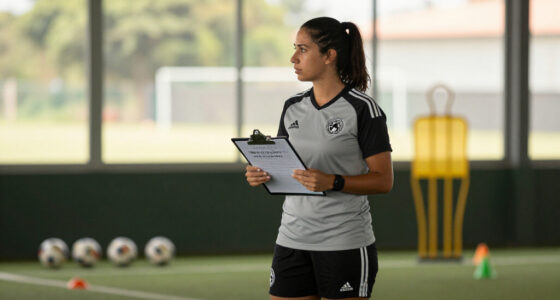
To handle cluttered backgrounds quickly, position yourself to avoid busy elements and shoot from angles that block spectators or distracting banners. Use wide apertures like f/2.8 or f/4 to blur backgrounds and make athletes stand out sharply. Anticipate athlete movements to pre-focus on key areas, and swiftly adjust your framing to minimize distractions. Staying alert and adaptable guarantees you capture sharp, impactful images even in fast-paced scenarios. Keep exploring techniques to refine your approach further.
Key Takeaways
- Use wide apertures (f/2.8 or f/4) to blur distracting backgrounds quickly.
- Select shooting angles that naturally block or minimize spectator presence.
- Focus on the athlete’s eyes or key movement points to maintain sharpness amidst clutter.
- Employ pre-focus and anticipate athlete movement for rapid, accurate focusing.
- Crop images post-shoot to remove remaining background clutter effectively.
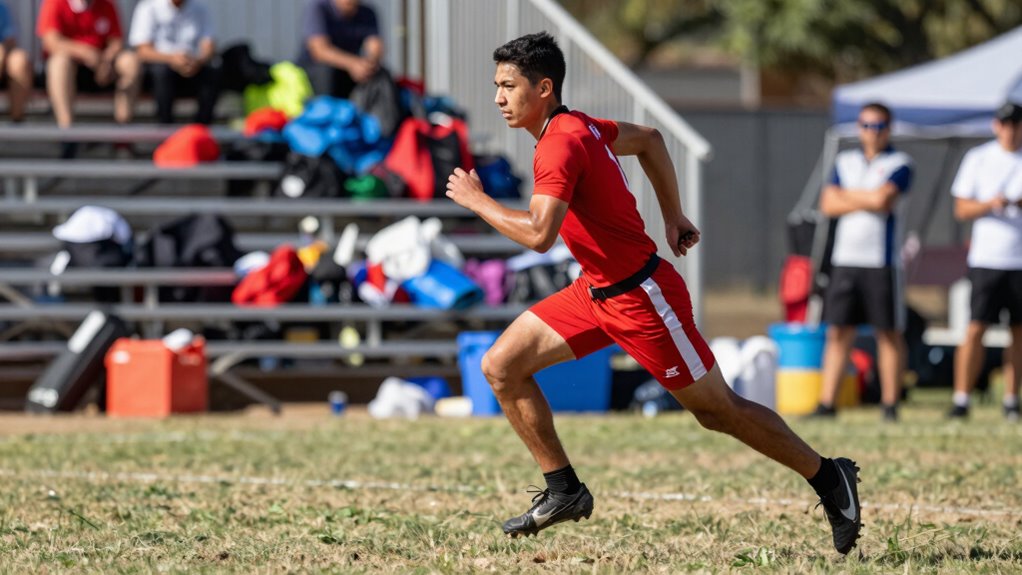
When photographing sports fields with cluttered backgrounds, your goal is to make the athletes stand out despite the distractions. Spectator distractions, such as moving fans, banners, or even other players, can easily pull focus away from your subject. To minimize this, you need to stay sharp on your camera focus and use techniques that help isolate your athlete from the chaos around them. The key is to quickly adapt your settings and framing so that the action remains clear and compelling, even when time is limited.
Start by choosing a wide aperture, like f/2.8 or f/4, to create a shallow depth of field. This blurs the background, reducing the impact of spectator distractions and making your athlete pop out sharply. When you do this, your camera focus becomes even more critical. Use continuous autofocus (AI Servo or AF-C mode) and make sure your focus point is precisely on the athlete’s eyes or the part of the body that’s in motion. This way, even if the background is busy, your camera will prioritize the athlete’s sharpness.
Use wide apertures and continuous autofocus to make athletes stand out against busy backgrounds.
Don’t rely solely on autofocus points; anticipate the athlete’s movement. As you see them approaching, pre-focus on a spot where they’ll be, so when the action arrives, your camera quickly locks focus. In fast-paced sports, you often don’t have the luxury to fine-tune focus after the fact, so preemptive focus is essential. Additionally, consider using a shutter speed of at least 1/1000 second to freeze motion. This ensures your images are crisp, even when the athlete is moving swiftly, preventing motion blur that could make the subject blend into the background.
When framing your shot, position yourself to minimize clutter in the background—if possible, shoot from angles that block or reduce the presence of spectators. Sometimes, a slight tilt or change in position can make a big difference. If you’re limited in movement, crop the image afterward to remove distracting elements, but do so carefully to preserve image quality. You can also use focus techniques to better isolate your subject and improve image clarity. Paying attention to background control can further help in creating a clean, distraction-free composition.
Finally, stay alert and quick. In sports photography, moments happen in seconds, and your ability to adapt your focus and composition on the fly makes all the difference. By controlling your camera focus, utilizing a wide aperture, and choosing angles that limit spectator distractions, you’ll capture sharp, impactful images even amidst chaos. Speed is essential, but precision in focus and framing ensures your subjects stand out amid the clutter.
professional sports camera lens f/2.8
As an affiliate, we earn on qualifying purchases.
As an affiliate, we earn on qualifying purchases.
Frequently Asked Questions
How Can I Quickly Identify Key Players in a Cluttered Background?
You can quickly identify key players by focusing on player recognition techniques like observing jerseys, unique movements, or equipment. Use background isolation tools or software to blur or separate players from the cluttered background, making them stand out more clearly. Speed is essential, so practice scanning the field efficiently, honing your ability to pick out the main players amidst chaos. This approach guarantees you don’t miss critical moments on the field.
What Camera Settings Help Reduce Background Distraction During Fast Plays?
To reduce background distraction during fast plays, set a wide aperture to create a shallow depth of field, which blurs out cluttered backgrounds and emphasizes your main subject. Adjust your shutter speed to minimize motion blur, capturing sharp, clear images of quick movements. Use a fast autofocus mode to keep players in focus, and consider increasing ISO if lighting is low, ensuring your camera settings work together for clean, distraction-free shots.
Are There Specific Lenses Best Suited for Shooting in Crowded Sports Environments?
You should choose prime lenses or telephoto lenses for crowded sports environments. Prime lenses offer sharp images and wide apertures, helping you isolate subjects from busy backgrounds. Telephoto lenses allow you to zoom in on fast-moving action from a distance, minimizing background clutter. Both types are ideal for capturing sharp, detailed shots during fast plays, making them the best options to handle crowded fields effectively.
How Can I Improve Focus Accuracy Amidst Busy Backgrounds?
Think of your camera as a sniper aiming through a busy cityscape. To improve focus accuracy amid cluttered backgrounds, use a narrow depth of field to blur distractions and isolate your subject. Keep your shutter speed high to minimize motion blur, ensuring sharpness even at fast speeds. Practice focusing on the athlete’s eyes, and you’ll find your shots become clearer and more precise, even in chaotic environments.
What Post-Processing Techniques Effectively Minimize Background Clutter?
To minimize background clutter, start with color correction to enhance your subject’s visibility and reduce distractions. Use noise reduction tools to smooth out grainy areas, especially in low-light conditions. Additionally, apply selective blurring or masking to further isolate your subject from busy backgrounds. These post-processing techniques help focus attention on the main action, making your shots clearer and more impactful despite the cluttered environment.
As an affiliate, we earn on qualifying purchases.
Conclusion
When you face cluttered backgrounds at sports fields, think of yourself as a skilled sailor steering through a stormy sea—focused and adaptable. Use your techniques to isolate your subject and let the chaos fade into the background. With quick thinking and a steady hand, you’ll turn a cluttered scene into a compelling shot that captures the essence of the game. Remember, in the midst of chaos, your vision is your guiding star.

SPORT PHOTOGRAPHY: A Practical Guide to Capturing Fast Action and Emotion
As an affiliate, we earn on qualifying purchases.
As an affiliate, we earn on qualifying purchases.
background blur lens for sports photography
As an affiliate, we earn on qualifying purchases.
As an affiliate, we earn on qualifying purchases.