
To avoid regret when shopping for telephoto lenses for your mirrorless sports kit, first, check compatibility with your camera mount. Look for focal lengths between 200mm and 400mm to capture distant action clearly. Prioritize wider apertures for various lighting conditions, and consider image stabilization features to reduce blur. Finally, read reviews to gauge real-world performance and autofocus speed. Stick around to discover more tips that’ll help you make the best lens choice.
Key Takeaways
- Verify lens compatibility with your specific mirrorless camera mount to avoid disappointment.
- Choose a focal length between 200mm and 400mm for optimal sports photography results.
- Opt for lenses with wider apertures (like f/2.8) to handle varying lighting conditions effectively.
- Look for image stabilization features to reduce motion blur and enhance image sharpness during action shots.
- Read reviews and watch sample videos to assess real-world performance and autofocus capabilities before purchasing.
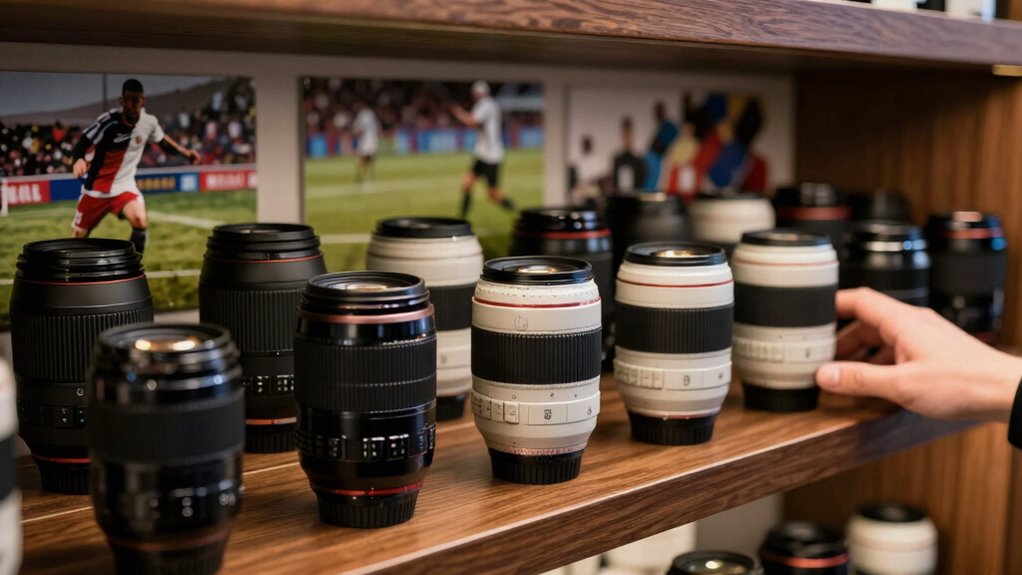
When you’re shopping for telephoto lenses, it’s easy to feel overwhelmed by the options available. You might find yourself staring at a wall of lenses, each boasting different features and specs. To avoid regret, start by considering lens compatibility with your mirrorless sports kit. Not all lenses fit every camera, and using the wrong one can lead to disappointing results. Check your camera’s mount type and verify any lens you’re eyeing is compatible. If you don’t, you could end up with a beautiful lens that’s useless for your setup.
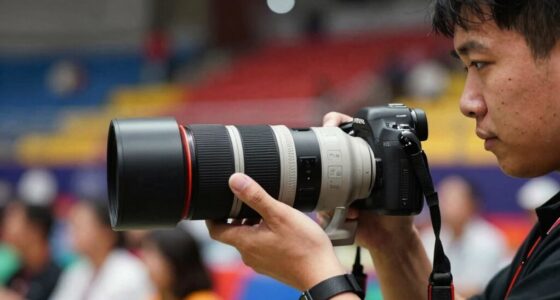
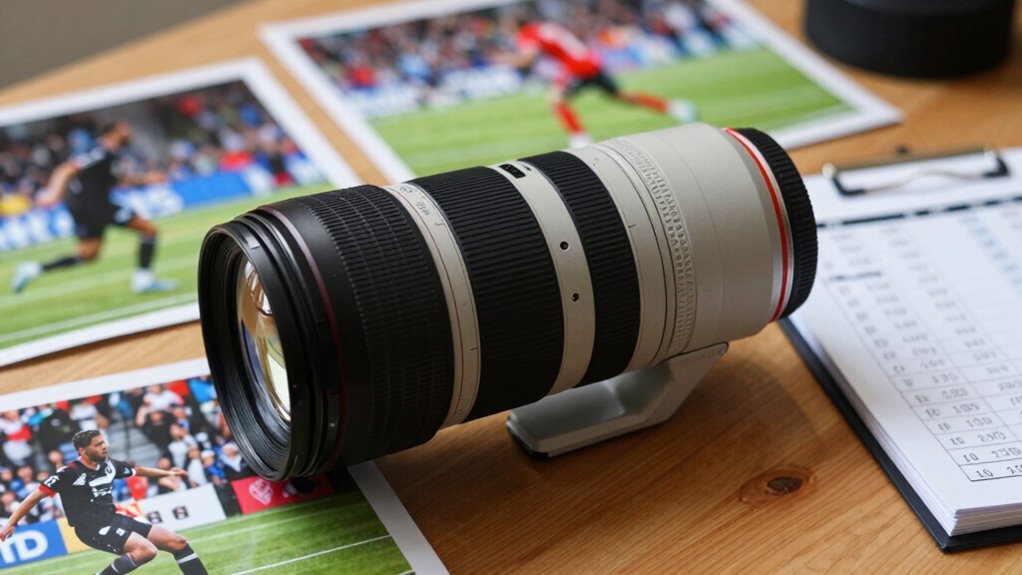
Next, think about the focal length you need. Telephoto lenses span a range of focal lengths, from 70mm to 600mm or more. Your choice should depend on what you plan to shoot. For sports photography, a focal length of around 200mm to 400mm is often ideal. This range lets you capture action from a distance without losing detail. If you choose a lens with too short a focal length, you might struggle to get the shots you want, especially in large venues. Additionally, considering the lens’s zoom range can help you adapt to different shooting scenarios more effectively. Being aware of the lens versatility can ensure you select a lens that grows with your skills and needs.
Choosing the right focal length is crucial; for sports, aim for 200mm to 400mm to capture distant action with clarity.
Once you’ve narrowed down options based on compatibility and focal length, consider the lens’ aperture. A wider aperture (like f/2.8) will let in more light, helping you shoot in various lighting conditions. This is especially useful in sports settings, where lighting can change quickly. However, wider apertures often come with a higher price tag. Balance your budget with your needs, and don’t hesitate to explore third-party lenses that might offer similar performance at a lower cost. You might also want to look into lens coatings, which can improve image quality and reduce flare in bright conditions. Additionally, understanding the lens construction can provide insights into the durability and overall image quality of the lens.
Don’t forget about image stabilization features, either. Sports photography often involves motion, both from your subjects and from yourself. A lens with good stabilization can help you capture sharper images, reducing the blur that can come from handheld shooting. If you’re often on the move, this feature can be a game changer. Additionally, understanding lens compatibility and how it relates to your camera system can save you from costly mistakes.
Finally, read reviews and watch sample videos. Seeing how a lens performs in real-world situations gives you a clearer picture than specs alone. Pay attention to feedback regarding autofocus speed and image quality, especially if you’re planning to shoot fast-paced action. By taking these steps, you can make an informed choice, confirming you select a telephoto lens that fits your mirrorless sports kit perfectly, minimizing the chances of regret later on.

Canon RF100-400mm F5.6-8 is USM Telephoto Lens, Black, Compatible with EOS R Series Mirrorless Cameras
- Lens Type: Telephoto zoom lens
- Zoom Range: 100-400mm
- Size and Weight: Compact and lightweight
As an affiliate, we earn on qualifying purchases.
As an affiliate, we earn on qualifying purchases.
Frequently Asked Questions
What Are the Best Brands for Telephoto Lenses?
When you’re looking for the best brands for telephoto lenses, consider Canon, Nikon, Sony, and Sigma. These brands have strong reputations for quality and performance. Make certain to check lens compatibility with your mirrorless camera to avoid any issues. Tamron and Fujifilm also offer excellent options, depending on your specific needs. Ultimately, choosing a reputable brand guarantees you’ll get a lens that enhances your photography experience and meets your requirements.
How Do I Determine the Right Focal Length?
To determine the right focal length, consider that over 60% of sports photographers prefer a focal length between 200mm and 400mm for wildlife and action shots. Think about your shooting style and the distance from your subject. Check your camera’s lens compatibility to guarantee the lens fits your mirrorless kit. If you often shoot from afar, opt for longer focal lengths; if you’re closer, shorter might work better for you.
Are Third-Party Lenses Worth Considering?
Absolutely, third-party options can be worth considering! They often provide great value and can offer unique features that suit your needs. Just make sure to check lens compatibility with your mirrorless camera system. Some third-party lenses perform exceptionally well, sometimes rivaling brand-name options. Research user reviews and test out a few models if you can. It’s a smart way to expand your choices without breaking the bank.
What Is the Importance of Lens Stabilization?
Lens stabilization acts like a steady hand in a storm, ensuring your images remain sharp and vibrant. It’s essential for maintaining image quality, especially in fast-paced sports scenarios. Without stabilization, you risk blurry shots, which can hurt your autofocus performance. When you’re capturing that winning moment, you want crisp detail, not shaky memories. So, investing in a lens with stabilization can elevate your photography, giving you confidence in every click.
How Can I Test a Lens Before Buying?
To test a lens before buying, try it out on your camera body to guarantee lens compatibility. Check the focal length by zooming in and out, observing how it performs in various lighting conditions. Take sample shots, focusing on both stationary and moving subjects. Pay attention to sharpness and stabilization. If possible, compare it with other lenses to see which one suits your needs best. Trust your instincts—don’t settle for less!

Canon RF 100-400mm f/5.6-8 IS USM Lens | Lightweight Telephoto Zoom with Optical Image Stabilization, Fast Nano USM AF & Compact Design | For Wildlife & Sports Photography (5050C002) + 64GB Card + Bag
- Includes Camera Bag and 64GB Card: Complete photography kit
- Lightweight Telephoto Zoom Lens: Ideal for wildlife and sports
- Optical Image Stabilization: Reduces camera shake for sharp images
As an affiliate, we earn on qualifying purchases.
As an affiliate, we earn on qualifying purchases.
Conclusion
As you commence your journey through the lens forest, remember to choose wisely, like a skilled archer selecting the perfect bow. Each telephoto lens is a tool that can either sharpen your aim or lead you astray. Trust your instincts, weigh your options, and don’t rush—patience will reveal the clearest paths. By staying true to your vision, you’ll guarantee your shots capture the heart of the game, free from the shadows of regret.
Canon RF100-400mm F5.6-8 is USM Telephoto Lens, Black, Compatible with EOS R Series Mirrorless Cameras
- Lens Type: Telephoto zoom lens
- Zoom Range: 100-400mm
- Size and Weight: Compact and lightweight
As an affiliate, we earn on qualifying purchases.
As an affiliate, we earn on qualifying purchases.