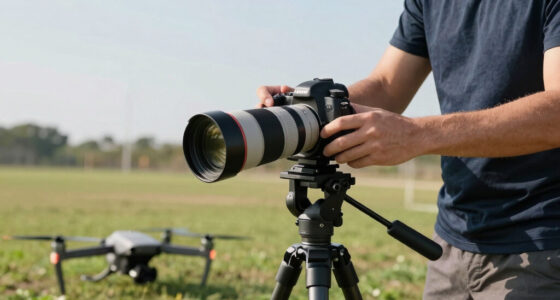
Choosing among the best cameras for football photography means deciding how much action speed and reliable focus matter next to cost, reach, and ease of use. My strongest performance pick is the Nikon D7500: its 8 fps burst rate is far better suited to following a play than the Rebel T7 cameras, though its included 420–800mm lens is manual-focus and needs careful handling. For a lighter beginner kit, the Canon EOS R100 offers a modern mirrorless setup and autofocus advantages, but its bundled telephoto lens is still an entry-level, relatively slow lens. The Canon EOS Rebel T7 double-lens kits are more approachable ways to start, with a 75–300mm lens for sideline reach, yet their 3 fps shooting and basic autofocus make fast sequences harder to capture.

Get sports gear delivered free with Prime
- Fast, free delivery on millions of items
- Prime Video, Amazon Music and more included
- Member-only deals all year
My ranking puts football action ahead of headline resolution or accessory count. That distinction matters because a camera can make detailed pictures and still miss the peak of a sprint, tackle, or goal celebration. I also separate the closely related T7 bundles by what they add: a standard two-lens kit, a larger accessory bundle with an unusual preset lens, and a renewed option. The best fit depends on whether you want a practical first kit, a more responsive body, or extra reach and are willing to manage the limitations that come with it.
Complete the kit



Key Takeaways
- Nikon D7500 is the action-first choice: its 8 fps burst rate beats the T7 cameras’ 3 fps, but the included 420–800mm lens is manual-focus.
- Canon EOS R100 is the lighter modern alternative: it pairs mirrorless handling and advanced autofocus features with a 75–300mm telephoto, though that lens remains slow in dim light.
- All three Rebel T7 options share the same central football limitation: 3 fps shooting and a 9-point autofocus system make it harder to follow rapid sequences than the D7500.
- The 75–300mm lens adds useful sideline reach: it can frame distant players more tightly than the standard zoom, but its aperture can constrain shutter speed when light drops.
- Bundle size is not the same as football readiness: the renewed T7’s preset 500mm lens and the D7500’s 420–800mm manual lens need more technique than a beginner may expect.
| Nikon D7500 DSLR Camera Bundle with 18-140mm and 420-800mm Lenses, 128GB Card, Extra Battery and Accessories (Renewed) |  | Best for action and experienced sideline shooters | Sensor: 20.9MP DX-format APS-C CMOS | Processor: EXPEED 5 | Continuous shooting: Up to 8 fps | VIEW LATEST PRICE | See Our Full Breakdown |
| Canon EOS R100 Mirrorless Camera with 18-45mm & 75-300mm Double Lens Bundle |  | Best lightweight mirrorless choice for newer photographers | Sensor: 24.2MP APS-C CMOS | Processor: DIGIC 8 | Included lenses: 18–45mm f/4.5–6.3 IS STM and 75–300mm f/4–5.6 | VIEW LATEST PRICE | See Our Full Breakdown |
| Canon EOS Rebel T7 DSLR Camera with 18-55mm & 75-300mm Double Lens Bundle |  | Best beginner DSLR kit for learning football photography | Sensor: 24.1MP APS-C CMOS | Autofocus: 9-point system | Continuous shooting: Not specified in this bundle description | VIEW LATEST PRICE | See Our Full Breakdown |
| Canon EOS Rebel T7 DSLR Camera Double Zoom Lens Kit |  | Best basic T7 kit for buyers who want wireless sharing | Sensor: 24.1MP APS-C CMOS | Autofocus: 9-point AF with AI Servo AF | Continuous shooting: Up to 3 fps | VIEW LATEST PRICE | See Our Full Breakdown |
| Canon EOS Rebel T7 DSLR Camera Bundle with 18-55mm IS II, EF 75-300mm III, and 500mm Preset Lens, 32GB Memory and Accessories (Renewed) |  | Best renewed bundle for buyers who want extra lens options | Sensor: 24.1MP APS-C CMOS | Autofocus: Basic 9-point T7 autofocus system | Continuous shooting: Up to 3 fps | VIEW LATEST PRICE | See Our Full Breakdown |
| cameras for football photography | Sensor | Video | Included lenses | Continuous shooting |
|---|---|---|---|---|
| Nikon D7500 DSLR Camera Bundle | 20.9MP DX-format APS-C CMOS | 4K UHD | 18–140mm f/3.5–5.6G ED VR and 420–800mm f/8 manual telephoto | Up to 8 fps |
| Canon EOS R100 Mirrorless Came | 24.2MP APS-C CMOS | 4K capability | 18–45mm f/4.5–6.3 IS STM and 75–300mm f/4–5.6 | — |
| Canon EOS Rebel T7 DSLR Camera | 24.1MP APS-C CMOS | Full HD 1080p at 30p | EF-S 18–55mm f/3.5–5.6 IS II and EF 75–300mm f/4–5.6 III | Not specified in this bundle description |
| Canon EOS Rebel T7 DSLR Camera | 24.1MP APS-C CMOS | Full HD 1080p | EF-S 18–55mm and EF 75–300mm | Up to 3 fps |
| Canon EOS Rebel T7 DSLR Camera | 24.1MP APS-C CMOS | Full HD 1080/30p | 18–55mm IS II, 75–300mm III, and 500mm preset lens | Up to 3 fps |
More Details on Our Top Picks
Nikon D7500 DSLR Camera Bundle with 18-140mm and 420-800mm Lenses, 128GB Card, Extra Battery and Accessories (Renewed)
The Nikon D7500 is the strongest action camera in this group on the specification that most directly changes football coverage: it can shoot up to 8 frames per second. That gives me more frames to choose from during a fast run or a tackle than any of the Canon T7 options, which are listed at 3 fps. Its 20.9MP APS-C sensor is not the highest-resolution sensor here, but the D7500’s burst performance and EXPEED 5 processor make it the more convincing body when action timing is the priority.
The bundle has two very different lenses. The 18–140mm zoom is the more practical everyday option, while the included 420–800mm f/8 lens is manual-focus. That extreme focal range can bring distant parts of a field closer, but it will not automatically track a player running toward the camera. I would treat it as a specialist lens for a photographer who can pre-focus, follow action deliberately, and accept a narrower set of usable moments. Unlike the R100’s autofocus-focused pitch or the T7’s beginner-friendly setup, this package asks more from the person behind the camera.
Its weather-sealed body, optical viewfinder, and tilting touchscreen suit long sessions in changing conditions and awkward shooting positions. The listing also says the camera is not water resistant, so I would not treat weather sealing as permission to shoot in heavy rain without protection. The renewed status and conflicting warranty descriptions in the bundle information also deserve attention before purchase. This is my top pick for football only when the buyer values speed and knows how to work around the long lens’s manual focus; a novice wanting reliable action tracking should look more closely at the R100.
Pros:- Up to 8 fps continuous shooting gives it the best action-sequence rate in this lineup.
- The 18–140mm lens is a more flexible everyday option than a standard 18–55mm kit zoom.
- Weather-sealed body, optical viewfinder, and tilting touchscreen support varied sideline conditions and angles.
- Bundle includes a large memory card and an extra battery for extended sessions.
Cons:- The 420–800mm f/8 telephoto lens is manual-focus, limiting dependable tracking of moving players.
- The bundle is renewed, and its description gives conflicting warranty periods.
- Weather sealing does not mean the camera is water resistant; wet-weather protection is still needed.
Best for: Football photographers who prioritize burst speed, already understand manual focus, and want a DSLR body with a practical standard zoom plus an extreme-reach lens.
Not ideal for: Beginners expecting the 420–800mm lens to autofocus, or buyers who need a simple, weatherproof setup for wet games.
- Sensor:20.9MP DX-format APS-C CMOS
- Processor:EXPEED 5
- Continuous shooting:Up to 8 fps
- Video:4K UHD
- Included lenses:18–140mm f/3.5–5.6G ED VR and 420–800mm f/8 manual telephoto
- Display:3.2-inch tilting touchscreen
- Viewfinder:Optical
- Weather protection:Weather-sealed body; listed as not water resistant
Our verdict“I rank the D7500 first for its 8 fps action pace, but only experienced shooters should count on the manual 420–800mm lens for football.”
Canon EOS R100 Mirrorless Camera with 18-45mm & 75-300mm Double Lens Bundle
The Canon EOS R100 is the more modern, portable-feeling option compared with the three Rebel T7 kits. It uses a 24.2MP APS-C sensor and is described as offering Dual Pixel autofocus and Eye Detection AF, features that may help a newer photographer acquire a subject more naturally than the T7’s 9-point system. Those advantages do not erase the need to follow a player and choose a fast shutter speed, but they give the R100 a stronger starting point for keeping a subject sharp.
Its two-lens package includes an 18–45mm standard zoom and 75–300mm telephoto. For football, the telephoto is the important lens: it gives a spectator or sideline shooter a tighter view of players than the standard zoom can. The kit’s lighter mirrorless body is also appealing when carrying gear around a field or between games. Compared with the Nikon D7500, however, the provided information does not state a continuous-shooting rate, so I cannot rank it above the Nikon on burst performance. Its 75–300mm lens is also relatively slow, with an f/4–5.6 aperture, making bright daylight more comfortable than dim evening games.
The R100 offers 4K video capability, but that is a secondary benefit for a buyer focused on still football photographs. The product information calls out a battery and charger but no built-in flash; flash is rarely the answer for distant field action, though its absence may matter for casual nearby pictures. Compared with the T7 bundles, I would choose this kit for its mirrorless format and autofocus features rather than assume that a newer body or video mode guarantees a higher keeper rate. It suits someone who values a lighter setup and a more current focusing approach, while those who prioritize a documented burst rate should examine the D7500 closely.
Pros:- 24.2MP APS-C sensor provides detailed still images.
- Dual Pixel autofocus and Eye Detection AF offer a more modern focusing feature set than the T7 kits.
- The 75–300mm lens provides useful reach for distant players.
- Mirrorless body is described as lighter than traditional DSLR systems.
Cons:- The included 75–300mm lens has a relatively slow maximum aperture for evening games.
- A continuous-shooting rate is not specified in the supplied product details.
- No built-in flash is included, which limits casual close-range use away from the field.
Best for: Newer football photographers who want an APS-C mirrorless body, a lighter two-lens kit, and autofocus features beyond the basic T7 setup.
Not ideal for: Buyers who need a confirmed fast burst rate, strong low-light performance from the included lenses, or an action kit with no learning curve.
- Sensor:24.2MP APS-C CMOS
- Processor:DIGIC 8
- Included lenses:18–45mm f/4.5–6.3 IS STM and 75–300mm f/4–5.6
- Autofocus:Dual Pixel autofocus and Eye Detection AF listed
- Video:4K capability
- Battery:LP-E17 lithium-ion
- Camera type:Mirrorless
- Weight:Described as lighter than traditional DSLR systems
Our verdict“I recommend the R100 to buyers who value lighter mirrorless handling and more advanced autofocus features over the D7500’s documented 8 fps burst speed.”
Canon EOS Rebel T7 DSLR Camera with 18-55mm & 75-300mm Double Lens Bundle
This Rebel T7 double-lens bundle is my most straightforward starter kit for a buyer learning how to photograph football. It combines a 24.1MP APS-C sensor, an optical DSLR viewfinder, and two lenses, including a 75–300mm telephoto that can frame action across more of the field than the 18–55mm zoom. Its simple positioning and included bag and memory card make it easier to begin with a complete basic setup than buying a body and lens separately.
The main limitation is not resolution; it is the camera’s ability to follow and record a rapid sequence. The 9-point autofocus system and 3 fps continuous shooting are modest for football, particularly compared with the D7500’s 8 fps. The T7 can still make sharp, detailed single frames when focus and timing are right, but a beginner will have fewer frames to choose from when a player changes direction or two players contest the ball. The 75–300mm lens helps with framing, yet its f/4–5.6 aperture is not especially bright, so fast action is easier to freeze under good daylight than during a night match.
Compared with the renewed T7 bundle, this package keeps the choice simpler: it provides the familiar 18–55mm and 75–300mm pair without adding a preset 500mm lens and a long list of accessories that can distract from learning. It is also less contemporary in focusing capability than the R100. I would still choose it for someone who wants an accessible DSLR foundation and accepts the limits of entry-level action performance. A buyer whose main goal is maximizing the number of sharply focused frames should move up to the Nikon, while a beginner who wants a lighter mirrorless body should compare the R100.
Pros:- 24.1MP APS-C sensor captures detailed still images.
- Included 75–300mm telephoto gives more field reach than the standard zoom.
- Beginner-friendly DSLR format and straightforward kit make it approachable for learning.
- Shoulder bag and 64GB memory card are included.
Cons:- 3 fps continuous shooting is much slower than the D7500’s 8 fps.
- The 9-point autofocus system is basic for tracking football action.
- Both included lenses can be limiting in low light, especially the telephoto zoom.
Best for: A first-time DSLR owner who wants a basic two-lens kit, an optical viewfinder, and a longer zoom for daytime youth or school football.
Not ideal for: Photographers covering fast action in dim stadium light or anyone who expects a high burst rate and advanced subject tracking.
- Sensor:24.1MP APS-C CMOS
- Autofocus:9-point system
- Continuous shooting:Not specified in this bundle description
- Video:Full HD 1080p at 30p
- Included lenses:EF-S 18–55mm f/3.5–5.6 IS II and EF 75–300mm f/4–5.6 III
- Memory card:64GB
- Accessories:Shoulder bag and memory card included
- Camera type:DSLR
Our verdict“I’d choose this T7 bundle as a simple daylight learning kit, not as the best tool for consistently capturing rapid football sequences.”
Canon EOS Rebel T7 DSLR Camera Double Zoom Lens Kit
This T7 double zoom kit has the same basic football strengths and limitations as the other Rebel T7 packages: 24.1MP resolution and a 75–300mm telephoto make it capable of framing detailed daylight action, while 3 fps shooting and a 9-point autofocus system trail the D7500 and the R100’s described autofocus features. I place it below the newer standard T7 bundle because the supplied package details do not list the bag and 64GB card included with that option. Its advantage is a clearly specified optical viewfinder, built-in Wi-Fi and NFC, and a more fully detailed set of camera specifications.
The optical viewfinder gives a direct way to follow players without composing on the rear screen, although its approximately 95% frame coverage means the finished image includes a little more around the edges than the viewfinder shows. AI Servo AF is listed, which is intended for moving subjects, but the nine-point layout and 3 fps rate still set a clear ceiling for action coverage. The T7 is better suited to learning timing, framing, and exposure than to high-volume sports work. Compared with the R100, it has a traditional DSLR viewfinder and a specified two-lens kit, but it does not offer the same stated Dual Pixel autofocus feature.
Built-in Wi-Fi and NFC can make sharing a selected image easier, which may matter to a parent who wants to send a picture after a game. Those wireless tools do not solve focus or burst-rate limits, and the included telephoto’s f/4–5.6 aperture still favors brighter conditions. The bundle’s stated 3-pound weight is also worth thinking about for long sessions. I would choose this version when the exact lens pairing and wireless sharing are the priorities; if a complete beginner wants a bag and card in the package, I would compare it with the B0FT3P6VRH kit instead.
Pros:- 24.1MP APS-C sensor supports detailed still photographs.
- 18–55mm and 75–300mm lenses cover general framing and longer sideline shots.
- Built-in Wi-Fi and NFC support wireless sharing.
- Optical viewfinder and AI Servo AF provide a familiar way to follow moving subjects.
Cons:- 3 fps continuous shooting gives fewer chances to capture a peak action moment than the D7500.
- The 9-point autofocus system is less capable than the R100’s described autofocus features.
- Approximately 95% viewfinder coverage does not show the full captured frame.
Best for: A beginner who wants a traditional optical-viewfinder DSLR, the standard 18–55mm and 75–300mm pairing, and built-in wireless sharing.
Not ideal for: Football shooters who need a high burst rate, advanced subject tracking, or a light kit for long periods on the sideline.
- Sensor:24.1MP APS-C CMOS
- Autofocus:9-point AF with AI Servo AF
- Continuous shooting:Up to 3 fps
- Included lenses:EF-S 18–55mm and EF 75–300mm
- Viewfinder:Optical, approximately 95% coverage
- Video:Full HD 1080p
- Connectivity:Wi-Fi, NFC, USB, and Mini-HDMI
- Weight:3 pounds
Our verdict“This is a sensible T7 option for learning and sharing images, but I would pick the faster Nikon or the more modern R100 for action-first football work.”
Canon EOS Rebel T7 DSLR Camera Bundle with 18-55mm IS II, EF 75-300mm III, and 500mm Preset Lens, 32GB Memory and Accessories (Renewed)
This renewed Rebel T7 package stands out for the sheer number of items included, most notably a preset 500mm lens alongside the familiar 18–55mm and 75–300mm zooms. The extra long lens may appeal to someone photographing distant action from a fixed position, but the listing does not describe it as an autofocus zoom. I would not treat the headline focal length as a shortcut to better football pictures: very long lenses are harder to hold steady and frame with, and a preset lens is less flexible when a play moves across the field. The D7500 bundle’s 420–800mm lens is also manual-focus, but its camera body at least brings an 8 fps burst advantage; this T7 remains at 3 fps.
At its core, the camera has the same 24.1MP APS-C sensor and Full HD 1080/30p video as the other T7 choices. Built-in Wi-Fi and NFC are useful for transferring selected images, while the basic autofocus system and slow continuous shooting remain the main obstacles for football. The accessory list includes a flash, filters, monopod, tripod, shoulder case, and card. Some of those pieces may be useful for general photography, but an accessory-heavy box does not make the camera track action better. I would pay closest attention to whether the preset 500mm lens is genuinely suited to the buyer’s technique and shooting position.
The renewed condition adds another decision point: the description says the camera has been inspected and tested, but a buyer should read the applicable warranty and returned-item terms rather than assume it matches a new kit. Compared with the standard T7 package, this is more appealing to someone who specifically wants to experiment with an extra long lens and can tolerate a heavier learning curve. For a first football camera, I prefer the simpler T7 kit or the R100; for action performance, the D7500 is the clearer body upgrade, provided its manual long lens is understood.
Pros:- 24.1MP APS-C sensor supports detailed still images.
- Includes 18–55mm, 75–300mm, and preset 500mm lens options.
- Wi-Fi and NFC provide a way to share selected images wirelessly.
- Bundle includes a card, case, monopod, tripod, filters, and other accessories.
Cons:- 3 fps continuous shooting and basic autofocus are limiting for fast football action.
- The preset 500mm lens may be difficult to frame and focus on moving players.
- Renewed condition means buyers should check the applicable warranty and return terms.
Best for: A budget-conscious or experienced buyer who wants a renewed T7 with multiple lens types and is comfortable experimenting with a preset long lens.
Not ideal for: Beginners expecting the 500mm lens to track players automatically, or football photographers who need dependable burst shooting and fast autofocus.
- Sensor:24.1MP APS-C CMOS
- Autofocus:Basic 9-point T7 autofocus system
- Continuous shooting:Up to 3 fps
- Included lenses:18–55mm IS II, 75–300mm III, and 500mm preset lens
- Video:Full HD 1080/30p
- Connectivity:Wi-Fi with NFC
- Memory card:32GB SDHC
- Condition:Renewed; inspection and warranty stated in listing
Our verdict“I would choose this renewed T7 only for its unusual lens variety, not for action performance, where the D7500 and R100 are stronger fits.”

How We Picked
I ranked these kits around the moments football photographers are trying to capture: a player breaking through a defensive line, a contested catch, a tackle, or a reaction immediately after a score. For those situations, continuous shooting and autofocus matter more than a small difference in megapixels. I gave the Nikon D7500 the lead because its 8 fps burst rate provides more chances to record a decisive instant than the T7 cameras’ 3 fps. That advantage does not make the bundle an effortless sideline setup, since its longest included lens uses manual focus.
Next, I weighed telephoto reach, lens handling, and light-gathering limits. A longer focal length helps frame players across a field, but a long lens is only useful when the photographer can focus it accurately and keep shutter speeds high enough to freeze motion. Each kit includes a telephoto option, but none should be mistaken for a bright professional sports lens. The R100 and T7 bundles pair their bodies with relatively slow 75–300mm zooms; the Nikon bundle adds extreme reach but asks the photographer to focus manually.
I also considered how easy each camera is to carry, learn, and use between plays. The R100 earns a distinct place for its mirrorless design and described autofocus features, while the Rebel T7 remains the simpler entry point for someone who wants an optical viewfinder and familiar DSLR controls. The three T7 packages share much of their core performance, so I distinguished them by package contents and buyer fit rather than pretending one has a faster camera body. Finally, I treated accessory claims cautiously: a memory card, bag, extra battery, or tripod can help with a first setup, but they do not replace responsive autofocus or a well-handled telephoto lens.
| cameras for football photography | Continuous shooting |
|---|---|
| Nikon D7500 DSLR Camera Bundle | Up to 8 fps |
| Canon EOS R100 Mirrorless Came | — |
| Canon EOS Rebel T7 DSLR Camera | Not specified in this bundle description |
| Canon EOS Rebel T7 DSLR Camera | Up to 3 fps |
| Canon EOS Rebel T7 DSLR Camera | Up to 3 fps |
Factors to Consider When Choosing Best Cameras For Football Photography
For football, my buying priorities start with focus, burst speed, and a usable telephoto lens, then move to resolution, video, and included accessories. The products here all include some form of long lens, but their camera bodies and focusing demands are very different. The points below help match those differences to the kind of games and shooting style you expect.
Prioritize action handling over megapixels
Every camera in this roundup offers enough resolution for useful football stills, but the bodies are not equally prepared for sequences. The Nikon D7500’s 8 fps rate gives it a clear advantage over the T7 models’ 3 fps when action changes quickly. A faster burst cannot fix poor timing or missed focus, but it gives you more frames around a tackle or a player’s release. The R100’s supplied information does not state a burst rate, so I would not assume it matches the Nikon based on its newer mirrorless design alone. If football is your main subject, give more weight to published action performance than to a small resolution difference.
Match autofocus to your experience
Football players move toward, away from, and across the camera, so focus has to keep up with changing distance. The Rebel T7’s 9-point autofocus system is a basic starting point, while the R100 listing describes Dual Pixel autofocus and Eye Detection AF. The D7500 offers the quickest stated burst rate here, but its bundled 420–800mm lens is manual-focus, so its action advantage is not a promise that every lens in the box will track players. A buyer who is still learning should favor a lens and body combination that feels manageable over the longest focal length printed on a lens.
Choose reach for your shooting position
A 75–300mm lens can be useful from a sideline or spectator area because it frames distant players more tightly than an 18–55mm or 18–45mm standard zoom. The D7500 bundle reaches much farther with its manual 420–800mm lens, and the renewed T7 bundle adds a preset 500mm lens. Extra reach can also magnify camera shake and make it harder to find a player in the viewfinder. If you stand close to the field, a moderate telephoto may be easier to work with; if you shoot from the stands, reach matters more, but autofocus and handling still count.
Plan for daylight, dusk, and indoor games
Fast shutter speeds help freeze a sprint, but a lens with a narrow maximum aperture lets in less light. The bundled 75–300mm lenses are listed at f/4–5.6, and the R100’s standard 18–45mm zoom is slower still at its long end. These kits are easier to use in bright outdoor conditions than at night under stadium lights. In dim settings, the photographer may need to raise ISO, accept a darker exposure, or use a slower shutter that shows motion. Since the lens is a major part of this tradeoff, do not assume a high-resolution sensor alone will make an entry-level telephoto behave like a bright sports lens.
Treat accessories as support, not performance
The T7 bundles include useful extras such as memory cards, bags, a monopod, tripod, or filters, and the D7500 package adds a card and spare battery. These can make a kit more convenient to take to a game. They do not improve autofocus tracking or continuous shooting, which are more directly tied to action capture. A monopod can support a long lens during a long game, but a tripod or a preset lens may not suit a photographer who needs to change position quickly. I would compare accessories only after deciding whether the camera body and lenses match the pace and distance of the matches you shoot.
Account for weight, condition, and weather
A long football session can make an awkward or heavy kit tiring, so portability is part of the decision. The R100 is described as lighter than traditional DSLR systems, while the T7 double zoom listing gives a 3-pound weight. The D7500 adds a weather-sealed body, but its listing also says it is not water resistant; protection is still needed in rain. Two of these packages are described as renewed, so check the current condition details, warranty, and return terms before choosing. For a buyer who wants an uncomplicated first purchase, the standard T7 bundle avoids some of the uncertainty and specialist-lens complexity found in the renewed packages.
Frequently Asked Questions
Which camera in this roundup is best for fast football action?
I rank the Nikon D7500 first for action because its stated 8 fps continuous shooting rate is well ahead of the Rebel T7 models’ 3 fps. That gives me more opportunities to capture the peak of a play. Its included 420–800mm lens is manual-focus, though, so the camera body’s speed does not make that lens an easy choice for tracking moving players. A buyer who needs autofocus simplicity should weigh the R100’s described autofocus features against the Nikon’s faster documented burst rate.
Are the Canon Rebel T7 kits good for football photography?
The Rebel T7 kits can work for learning football photography, particularly in daylight, and their 75–300mm lens provides useful reach for players farther away. Their shared weaknesses are a basic 9-point autofocus system and, where specified, 3 fps continuous shooting. Those limits make them less suitable for capturing long action sequences than the D7500. I would choose a T7 for an approachable DSLR starting point, not because it is the strongest body for demanding sports coverage.
Is a 75–300mm lens enough reach for a football game?
A 75–300mm lens is a practical starting point for many sideline and spectator positions, especially when the play is on the nearer half of the field. From distant stands, or when you want a tight frame of action at the opposite end, it may not fill the frame as much as a longer lens. Longer lenses can be harder to steady and focus, and the very long options in these bundles have notable compromises. I would choose based on where you are allowed to stand and whether reliable autofocus matters more than maximum reach.
Which option is the most beginner-friendly?
The standard Canon EOS Rebel T7 double-lens bundle is the simplest beginner DSLR choice here because it has a familiar optical-viewfinder format, two useful zooms, and a bag and card included. The EOS R100 is also aimed at newer photographers and adds a mirrorless body with the listed Dual Pixel autofocus and Eye Detection AF. I would choose the T7 for a straightforward DSLR learning kit, or the R100 if a lighter mirrorless setup and its autofocus features are more appealing. Neither removes the need to learn shutter speed and action tracking.
Can these kits handle night games or dim stadium lighting?
They can make pictures at night, but the included telephoto lenses are not especially bright, and fast-moving football usually calls for a fast shutter speed. The 75–300mm zooms are listed with maximum apertures around f/4–5.6, while the D7500’s 420–800mm lens is listed at f/8. In dim light, that can force a higher ISO or a compromise in exposure and motion freezing. I would favor daylight use with these bundled lenses and expect night games to challenge them more than the camera body specifications alone suggest.
Conclusion
My pick depends on the kind of football coverage you want. Choose the Nikon D7500 if action rate is your priority and you are prepared to use its manual 420–800mm lens carefully; it is the clear burst-speed leader. Choose the Canon EOS R100 if you want a lighter mirrorless kit and the listed autofocus features, while accepting that the included telephoto is still slow in low light. Choose the standard Rebel T7 bundle to learn DSLR photography with a simple two-lens setup and included basics, especially for daytime games. The T7 double zoom kit suits buyers who value Wi-Fi and NFC, while the renewed T7 bundle is best reserved for someone who specifically wants to experiment with its preset 500mm lens and extra accessories. For every option, I would treat lens handling and focus performance as more important than the number of items in the box.