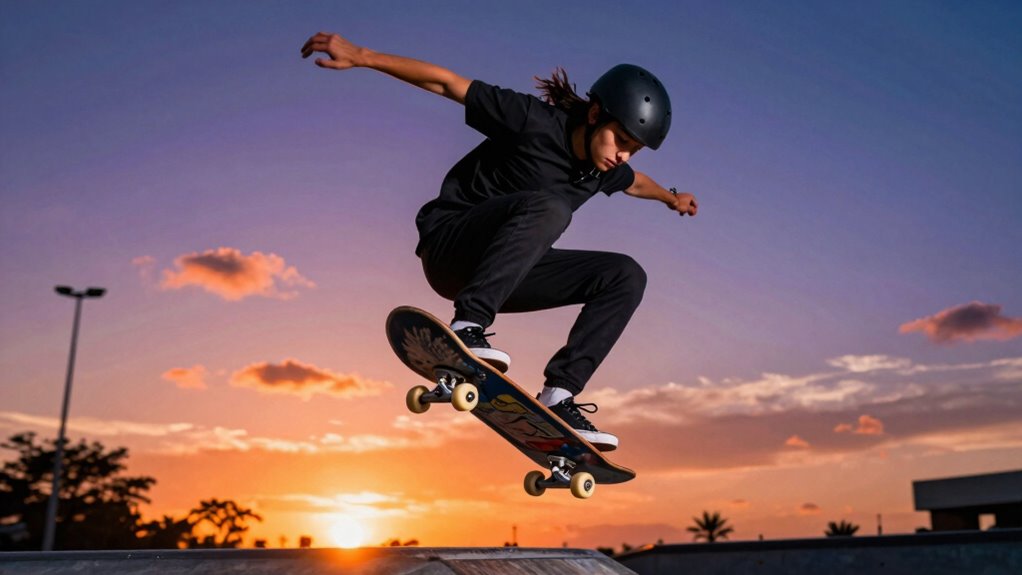

To master the exposure triangle for fast action, focus on balancing shutter speed, aperture, and ISO. Use faster shutter speeds (1/500s or more) to freeze motion, while adjusting ISO and aperture to maintain proper exposure. Panning or lowering shutter speed can create intentional motion blur. Experiment with these settings based on lighting conditions, gear, and scene speed. Keep practicing, and you’ll quickly improve your ability to capture sharp, dynamic action shots. If you continue exploring, you’ll discover even more techniques to perfect your photos.
Key Takeaways
- Master the exposure triangle—shutter speed, aperture, and ISO—to control motion and exposure in fast action photography.
- Use fast shutter speeds (e.g., 1/500s or higher) to freeze motion and capture sharp images.
- Adjust ISO to maintain proper exposure in varying lighting conditions without introducing excessive noise.
- Select appropriate gear, such as fast lenses, to improve autofocus and reduce motion blur.
- Practice balancing settings quickly to adapt to different lighting and movement scenarios for optimal results.

EF 85mm f1.8 Portrait Lens – MF for Canon EOS Rebel T8i/T7i/T7/T6i/T5/T3i/T3/T2i/XSi/XS/SL3/SL2/T100/90D/80D/70D/50D/5D Mark IV/6D II/7D II/1D X III II-Manual Focus DSLR Cameras Lenses(EF/EF-S Mount)
- Manual Focus Design: Fully manual focus for precision control
- Compatibility: For Canon EOS Rebel and DSLR cameras
- Focus Tips: Switch camera to full manual mode
As an affiliate, we earn on qualifying purchases.
As an affiliate, we earn on qualifying purchases.
How the Exposure Triangle Shapes Action Shots

The exposure triangle—comprising shutter speed, aperture, and ISO—directly influences how sharp and clear your action shots turn out. When you’re using an action camera, it’s essential to adjust these settings to freeze fast-moving subjects. A fast lens helps by allowing more light in, enabling quicker shutter speeds without sacrificing exposure. With a fast lens, you can set a high shutter speed to stop motion—perfect for capturing athletes or sports. Keep ISO low to reduce grain, but raise it if lighting is poor. The right balance ensures your images are crisp, with minimal motion blur. Mastering how each element interacts gives you the power to capture sharp, dynamic action shots that truly pop. Understanding exposure settings allows for better control over how motion is captured in various lighting conditions. Additionally, familiarizing yourself with digital camera tools can enhance your ability to fine-tune these settings quickly and efficiently. Remember, practicing with different camera modes can help you find the optimal settings for various action scenarios. Developing a good understanding of exposure controls can further improve your ability to adapt quickly during fast-paced shooting. Incorporating focusing techniques can also significantly improve the sharpness and clarity of your action shots.

Digital Camera,Autofocus 4K Vlogging Camera for Photography with 32GB Card,48MP Portable Compact Point and Shoot Digital Camera for Teens Adult Beginner with 16X Zoom,Anti-Shake,2 Batteries(Black)
- 4K UHD Video & 48MP Photos: Capture high-resolution images and videos
- 16X Digital Zoom: Zoom in on distant subjects
- Versatile Shooting Modes: Includes smile capture, continuous shot, self-timer
As an affiliate, we earn on qualifying purchases.
As an affiliate, we earn on qualifying purchases.
Mastering Aperture, Shutter Speed, and ISO for Action Photography

You need to control motion blur by choosing the right shutter speed, while adjusting ISO helps you maintain proper exposure in changing conditions. Balancing these settings guarantees your action shots are sharp and well-lit. Mastering how aperture, shutter speed, and ISO work together gives you the flexibility to capture fast-moving moments perfectly.
Controlling Motion Blur
Controlling motion blur is essential for capturing sharp, compelling action shots, and it hinges on mastering the interplay between aperture, shutter speed, and ISO. To prevent unwanted motion streaks, you need a fast shutter speed, typically 1/500 second or quicker, depending on the subject’s speed. When panning, you move the camera along with your subject, keeping it sharp while blurring the background to convey motion. This technique requires a slightly slower shutter speed, around 1/30 to 1/125 second, to create a dynamic sense of speed. Adjust your ISO upward if lighting is low, so you can maintain fast shutter speeds without underexposing your shot. Practice panning consistently to refine your control over motion blur and achieve crisp action images.
Adjusting Sensitivity Levels
How can you effectively adjust sensitivity levels to freeze fast motion and maintain sharpness in action shots? The key is understanding sensor sensitivity and ISO adjustments. Increasing ISO makes your camera sensor more sensitive to light, which allows you to use faster shutter speeds without underexposing your image. This helps freeze rapid movement and reduces motion blur. However, higher ISO can introduce noise, so find a balance that maintains image quality. When photographing fast action, set your ISO higher than usual if lighting conditions are low, enabling quicker shutter speeds for sharpness. Remember, adjusting sensor sensitivity impacts exposure, so combine it with appropriate aperture and shutter speed settings for ideal results. Mastering ISO adjustments empowers you to capture crisp, dynamic action shots in various lighting conditions.
Balancing Exposure Settings
Achieving sharp action shots requires balancing your camera’s exposure settings to work together seamlessly. In fast-paced situations, lighting conditions vary, so adjusting aperture, shutter speed, and ISO is essential. Proper camera ergonomics help you make quick adjustments without losing stability. Here’s a quick guide:
| Setting | Effect on Exposure | Best Use Case |
|---|---|---|
| Aperture | Controls depth of field | Wide for background blur, narrow for sharpness |
| Shutter Speed | Freezes motion | Fast for quick movements |
| ISO | Brightens image | Higher in low light, lower in bright conditions |
Mastering these settings ensures you capture action sharply, regardless of lighting or camera ergonomics. Being aware of outdoor bar equipment can also help you set up the right environment for action photography in outdoor settings.

Canon RF 100-400mm f/5.6-8 IS USM Lens | Lightweight Telephoto Zoom with Optical Image Stabilization, Fast Nano USM AF & Compact Design | For Wildlife & Sports Photography (5050C002) + 64GB Card + Bag
- Includes Camera Bag and 64GB Card: Complete photography kit
- Lightweight Telephoto Zoom Lens: Ideal for wildlife and sports
- Optical Image Stabilization: Reduces camera shake for sharp images
As an affiliate, we earn on qualifying purchases.
As an affiliate, we earn on qualifying purchases.
Setting the Perfect Shutter Speed to Freeze or Blur Motion

Choosing the right shutter speed is essential for capturing motion the way you want—either freezing fast action or creating a sense of movement through blur. Your shutter speed depends on lighting conditions and your equipment selection. In bright light, you can use faster speeds like 1/1000s to freeze rapid motion without overexposing. For low-light scenes, you might need to slow down to 1/250s or less, but this risks motion blur if your equipment isn’t stabilized. If you want to convey speed or movement, use slower shutter speeds, such as 1/30s or 1/60s, to introduce intentional blur. Remember, your camera’s capabilities and lens stability influence your choice. Adjusting shutter speed carefully guarantees you capture fast action crisply or add dynamic motion to your shots. Understanding exposure settings helps you make informed decisions for different shooting scenarios.

DSLR Cheat Sheet Photography Accessories Camera Accessories for Canon Nikon Sony Photography Gifts for Photographer Quick Reference Cards Guides Tips Settings Exposure Modes Composition And More 4×3in
- Includes 30 pages of tips: Color-coded double-sided cheat sheets
- Universal camera compatibility: Suitable for Canon, Nikon, Sony, and more
- Concise photography guidance: Easy-to-understand tips on exposure, modes, and composition
As an affiliate, we earn on qualifying purchases.
As an affiliate, we earn on qualifying purchases.
Adjusting Aperture and ISO for Proper Exposure in Fast Shots

When capturing fast-moving subjects, adjusting your aperture and ISO settings is vital to guarantee proper exposure without sacrificing image quality. Your lens selection and lighting conditions influence these choices. To get it right:
Adjust aperture and ISO to ensure sharp, well-exposed photos of fast-moving subjects in varying lighting conditions.
- Use a wide aperture (f/2.8 or lower) for more light, especially in low-light conditions, helping you keep shutter speeds high.
- Increase ISO when lighting is poor, but avoid going too high to prevent noise.
- In bright conditions, narrow your aperture and lower ISO to prevent overexposure while maintaining sharpness.
- Balance these settings based on your lens’s maximum aperture and the available light, ensuring your fast shots are clear, well-exposed, and sharp.
- Understanding the exposure triangle helps you make quick, effective adjustments tailored to fast-action photography.
Quick Tips for Shooting Fast Action Scenes

To capture fast action scenes sharply, you need to stay ready to adapt quickly. Use motion prediction to anticipate where your subject will be, helping you frame and focus faster. Keep your equipment stable—use a tripod or steady hand to minimize blur. Quick adjustments are essential; set a fast shutter speed to freeze motion. Practice panning smoothly to track moving subjects, maintaining focus as they move across your frame. Additionally, consider dust-proofing solutions to keep your gear clean and functioning optimally during high-movement shoots. Maintaining your gear’s proper maintenance can also prevent unexpected malfunctions during critical shots.
Common Mistakes to Avoid in Action Photography

Even experienced photographers can fall into common pitfalls when capturing fast action, but being aware of these mistakes helps you improve your shots. First, neglecting proper lighting techniques can lead to blurry or dark images; always guarantee enough light or adjust your camera settings accordingly. Second, poor equipment selection, like using a lens without fast autofocus, hampers sharpness during quick movements. Third, setting slow shutter speeds results in motion blur; prioritize faster speeds for crisp action shots. Fourth, ignoring your camera’s dynamic range can cause overexposed highlights or underexposed shadows. By focusing on ideal lighting techniques and choosing the right equipment, you’ll avoid these pitfalls and capture sharper, more vibrant action photos. Additionally, understanding camera gear essentials such as fast lenses and suitable settings can significantly enhance your ability to freeze motion effectively. Being familiar with exposure triangle concepts allows you to quickly adapt your camera settings for different lighting conditions and motion speeds. To improve your technique further, practicing with different camera settings in various scenarios can help build your confidence and responsiveness in fast-paced photography. Moreover, paying attention to ISO settings helps prevent grainy images when shooting in low light. Also, mastering the shutter speed component of the exposure triangle enables you to better control motion blur and freeze fast movements efficiently.
Frequently Asked Questions
How Does Lighting Affect Exposure Settings in Fast Action Photography?
Lighting directly impacts your exposure settings in fast action photography. When lighting is bright, you can use faster shutter speeds and lower ISO sensitivity to freeze motion without overexposing the shot. In low light, you’ll need slower shutter speeds or higher ISO sensitivity to capture enough light. Adjusting these settings carefully guarantees your images are sharp and well-exposed, regardless of changing lighting conditions during fast-paced scenes.
What Camera Modes Are Best for Capturing Fast-Moving Subjects?
You should use shutter priority or sports mode to capture fast-moving subjects. These modes automatically adjust shutter speed to freeze motion and reduce motion blur, ensuring sharp images. By selecting a fast shutter speed, typically 1/500 sec or faster, you prevent motion blur caused by rapid movement. This way, you keep your subject crisp, and your camera handles exposure settings efficiently for fast action shots.
How Can I Focus Quickly in Fast Action Shots?
Focusing quickly in fast action shots is like catching lightning in a bottle. Use continuous autofocus (AI Servo or AF-C) to track moving subjects, and employ focus techniques like selecting a single focus point or using dynamic area AF. Keep your shutter speed high to avoid motion blur, and pre-focus on a spot where action is expected. This combo guarantees sharp shots even when subjects race past in a blur.
What Accessories Improve Action Photography Results?
To improve action photography results, you should consider accessories that enhance lens stability and offer tripod alternatives. Use a monopod or a gimbal stabilizer to keep your camera steady during fast movements. These tools help reduce shake and motion blur, ensuring sharp images. Investing in lens stabilization features also boosts clarity. Together, these accessories allow you to capture crisp, dynamic shots even in challenging, fast-paced environments.
How Do Weather Conditions Impact Exposure Choices?
Weather impact markedly influences your exposure choices. On bright, sunny days, you’ll need to make exposure adjustments by lowering your ISO and increasing shutter speed to prevent overexposure. In cloudy or rainy conditions, open up your aperture or increase ISO to let in more light. Wind, rain, or snow can also affect your camera’s stability, so consider using protective gear and adjusting your settings accordingly to capture sharp, well-exposed images.
Conclusion
Mastering the exposure triangle unlocks your potential to capture stunning fast action shots. With a little practice, you’ll find it easier to freeze moments or create dynamic blurs that tell a story. Don’t worry if things don’t go perfectly at first—every shot is a stepping stone. Keep experimenting, stay curious, and soon you’ll be seamlessly translating your vision into enthralling images. Your journey into action photography is just beginning—embrace the adventure ahead!