
To choose lenses for side-of-field photography without overbuying, focus on moderate focal lengths like 50mm or 85mm for versatility in portraits and candid shots. Start with one or two prime lenses for their lightweight and affordable nature. A mid-range zoom, like 24-70mm, offers flexibility for various shots. Prioritize lenses with wider apertures for low-light conditions and consider durability and compatibility with your camera. Stick to intentional selections to enhance your skills and maximize your investment. More tips await!
Key Takeaways
- Start with a 50mm or 85mm prime lens for versatile side-of-field shots and beautiful bokeh without needing a costly telephoto lens.
- Consider a mid-range zoom lens like 24-70mm for flexibility to switch between wide and close-up shots.
- Choose lenses with a wider aperture (f/1.8 or f/2.8) to effectively capture images in low-light conditions.
- Prioritize lens compatibility and durability to ensure optimal performance and longevity in various shooting environments.
- Focus on one or two versatile lenses that align with your shooting style to avoid unnecessary purchases.

When it comes to photography, the right lens can make all the difference. If you’re diving into side-of-field photography, understanding how to choose the right lenses without breaking the bank is essential. You don’t need a massive collection of lenses to capture stunning images; you just need to know what to look for.
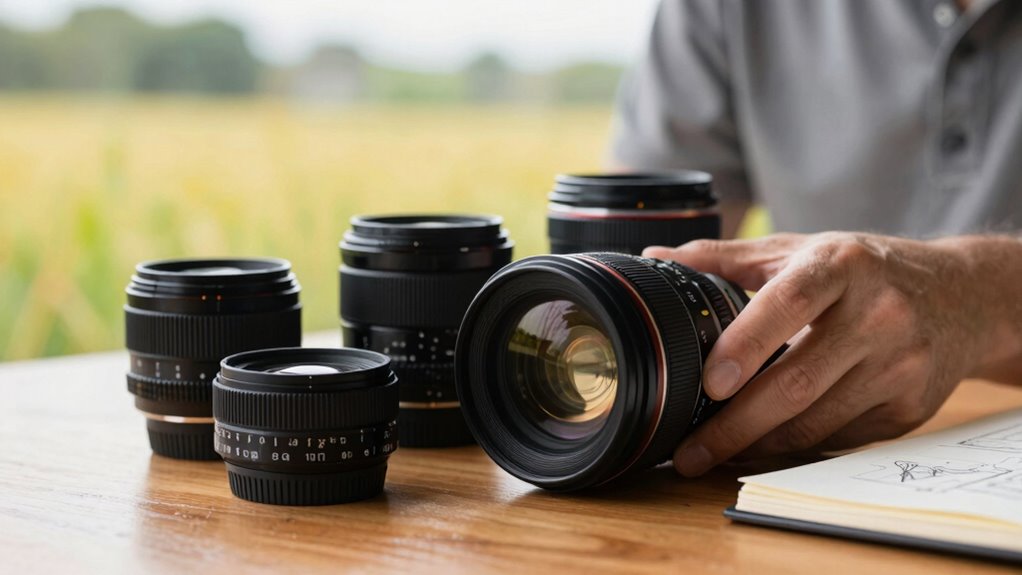
First, consider the focal length. This measurement determines how much of a scene you can capture and how close you can get to your subject. For side-of-field photography, a lens with a moderate focal length, like a 50mm or 85mm, might be ideal. These lenses allow you to focus on specific subjects while still capturing some of the surrounding context. They’re versatile enough for portraits and can also work well for candid shots, giving you that beautiful bokeh effect without needing to invest in a telephoto lens right away.
Consider a 50mm or 85mm lens for side-of-field photography; they balance subject focus with context, perfect for portraits and candid shots.
Next, think about lens types. Prime lenses are a great option if you want to keep your setup lightweight and affordable. They have a fixed focal length, which encourages you to move around and find the best composition. This can lead to more creative shots and help you develop your skills. On the other hand, zoom lenses offer flexibility, allowing you to adjust the focal length without changing lenses. A mid-range zoom, like a 24-70mm, can be perfect for side-of-field work, letting you easily switch between wide shots and detailed close-ups.
Make sure to evaluate your shooting style and the conditions you typically find yourself in. If you often shoot in low light, consider investing in a lens with a wider aperture, such as f/1.8 or f/2.8. This will help you capture clearer images without needing an external flash. Additionally, understanding lens characteristics can help you make more informed decisions tailored to your photography needs. Investing in lens quality is also crucial, as it can significantly impact your image sharpness and overall results. Recognizing the importance of sensor compatibility can further ensure that your lenses perform optimally with your camera body. Being aware of lens durability can also help you choose options that will withstand different shooting environments and last longer. Moreover, understanding how lens coatings reduce flare and ghosting can improve image quality in challenging lighting situations.
Lastly, don’t be lured into buying every lens you see. Focus on what you need for your specific style and environment. Start with one or two versatile lenses that suit your focal length needs. You can always add more as you refine your skills and discover what works for you. By being intentional about your choices, you can avoid overbuying and build a collection that truly enhances your photography. Remember, it’s not about how many lenses you have; it’s about how well you can use them.

Sony – FE 50mm F1.8 Standard Lens (SEL50F18F/2), Black
- Large F1.8 Aperture: Creates beautiful defocusing effects
- 7-Blade Circular Aperture: Produces smooth, attractive bokeh
- Compact and Lightweight: Ideal for full-frame e-mount cameras
As an affiliate, we earn on qualifying purchases.
As an affiliate, we earn on qualifying purchases.
Frequently Asked Questions
What Is the Difference Between Prime and Zoom Lenses?
The main difference between prime and zoom lenses lies in their lens types and construction. Prime lenses have a fixed focal length, offering sharper images and wider apertures, making them great for low light. Zoom lenses, on the other hand, provide versatile focal lengths in one lens, allowing you to frame subjects without changing lenses. However, they might sacrifice some image quality compared to primes. Knowing this can help you choose the right lens for your needs.
How Do I Know if a Lens Is Compatible With My Camera?
Finding a compatible lens is like matching puzzle pieces; it’s all about the right fit. Start by checking your camera’s lens mount specifications. Each camera brand has specific mounts, so guarantee the lens matches yours. You can usually find compatibility information on the manufacturer’s website or lens packaging. When in doubt, consult reviews or forums to confirm that the lens will work seamlessly with your camera setup.
What Focal Length Is Best for Landscape Photography?
For landscape photography, a focal length between 16mm and 35mm is often best. This range helps you capture expansive scenes and enhances your landscape composition. When considering focal length, think about how it influences depth and perspective. Wider angles can make foreground elements pop and draw viewers in. You’ll want to experiment with different lengths to see how they affect your images, ensuring you get the most out of your shots without overbuying.
Are Expensive Lenses Worth the Investment?
Expensive lenses can be worth the investment, especially when you consider cost versus performance. You’ll often find that higher-quality lenses provide sharper images, better low-light capabilities, and improved durability. In the long run, these advantages can save you money on replacements and repairs. If you’re serious about your photography, investing in a quality lens can enhance your work and provide long-term value that cheaper options simply can’t match.
How Does Aperture Affect Image Quality?
Aperture considerably affects image quality by controlling depth and light. A wider aperture lets in more light, enhancing low-light performance and creating beautiful background blur, or bokeh, which isolates your subject. It also allows for shallower depth control, making your images pop. Conversely, a smaller aperture increases depth of field, keeping more of the scene in focus. Balancing these factors helps you achieve the desired look without overcomplicating your gear choices.

Sony FE 24-70mm F2.8 GM Full-Frame Standard Zoom Lens
- Lens Mount: Sony E-mount for full-frame cameras
- Focus Features: Auto/manual focus with focus hold button
- Minimum Focus Distance: 0.38 meters
As an affiliate, we earn on qualifying purchases.
As an affiliate, we earn on qualifying purchases.
Conclusion
In conclusion, selecting suitable lenses for side field photography doesn’t have to be a stressful saga. By prioritizing purpose, performance, and practicality, you’ll pinpoint the perfect pair without overspending. Remember, it’s not about the number of lenses, but the quality of your captures that counts. So, simplify your search, stay savvy, and savor stunning shots that satisfy your artistic spirit. With thoughtful choices, you can create enchanting compositions without the clutter of excess.

Canon EF 50mm f/1.8 STM Lens, Black, Compatible with Canon EOS DSLR Cameras
- Focal Length: 50mm for versatile shooting
- Maximum Aperture: f/1.8 for bright images
- Ideal Uses: Portraits, action, night photography
As an affiliate, we earn on qualifying purchases.
As an affiliate, we earn on qualifying purchases.

72mm ND 1000 Filter, 10 Stop Fixed Neutral Density Filter for Camera Lenses
- Precise 10 Stop Light Reduction: Allows long exposures in bright conditions
- High-Quality Optical Glass: Made with German SCHOTT B270 glass
- Aviation-Grade Aluminum Frame: Ensures durability and lightweight design
As an affiliate, we earn on qualifying purchases.
As an affiliate, we earn on qualifying purchases.